| 1788 | The American War ended for English convicts, the transportation to and disposal in, the American colonies. It had been a very cheap form of penal servitude - just sell the convicts to a buyer who took them at his own expense to America and sold them for service matching the prison sentence.
On release the convicts were unlikely to find their own way back. Now the unwanted convicts had filled all the prisons and the available hulks of derelict ships on the Thames, and there was no more room, and guarding and feeding them was expensive.
In cunning desperation the English sent them to the Antipodes (the opposite point on the planet) without any preparation for locating, housing or feeding them. Not surprisingly, they nearly died of starvation before the second fleet arrived. Why send them so far, when the cost of transporting and supplying them at the far end of the earth was prohibitive, and there was no return cargo ? Some reasons, real and imagined, include:
|
| 1800 | England blessed the new colony with a vicious corrupt and drunken soldiery which ignored the governors, made their own laws and replaced the currency with rum, leading to major problems in health and crime. So began the Australian undying hatred of authority.
Merino sheep were introduced, originally from Spain, and their characteristic behaviour of moving in tight flocks, and grouping under threat with the rams running a protective circle around, enabled them to survive when, in the labor-shortage times of the gold-rush, shepherds and fences were scarce. The wool was bred to be the finest (thinnest) in the world, ideal for quality clothing, and in those cyclic years of high prices, made the squatters (farmers with thousands of sheep) wealthy. But the mercantilist policy of England (see Early empire) turned Australia into a primary resource colony, of wool, wheat and ores, of raw materials without value-adding; and this concept became so ingrained into the country's mentality, that it continues today, so that big companies imitate BHP Billiton, the largest ore producer, which dismantled our steel mills to re-build them in China, to process our ore for sending back to us as steel, and thus ensuring that Australia will soon become another Argentina. And the Australian government bends to the will of the big companies, the providers of their electioneering funds. |
| 1800 | England legislated to end the Atlantic slave trade:
|
| 1840 | ???? I am not sure but I think that in the 1850s, the unionists and guild members in Melbourne began the struggle for decent working conditions (such as the right to go to the toilet), and won the 8-hour working day in 1867. The Melbourne Trades Hall in Victoria Parade celebrates this, and there is a monument on the nearby corner. |
| 1850 | In 1851, the finding of alluvial (river-bed) gold was broadcast, causing a massive immigration and the beginning of anti-Chinese prejudice because of their huge numbers. The ratio was said to be 17:1 at Lambing Flats where 'Chinamen' were hung and humiliated. Even 100 years later, where I was a boy, the Chinese remained isolated from the rest of our community - very sad, especially when, as the market gardeners of Australia, they played a vital role in the health of our society.
In 1852, convict transportation ended after 160,000 convicts arrived in New South Wales and Tasmania since 1788. |
| 1860 | In the late 1860s, the alluvial gold was becoming scarce, and quartsite (rock-based) gold held the wealth. Mining was taken over by companies with finance for big machinery. |
| 1869 | The Suez Canal was opened, shortening the route for steamships. |
| 1870 | The 'little' man began to migrate. Desperate not to lose this population bonanza, governments offered to cut off small blocks of land from each of the big squatter leaseholds, and offer them for freehold. Lots of 'little' men jumped at it. But the wealthy squatters out-manouvred them, with bribes and dummy selectors and grabbing the blocks with creek and billabong water, so the little man was pushed out to the dry infertile land, to battle and starve, or leave vacant taking with him only his old age and poverty. And now the squatter had the same parcel of land but as freehold. We Australians believe we are a nation which stands for fair-play - we obviously don't know our history.
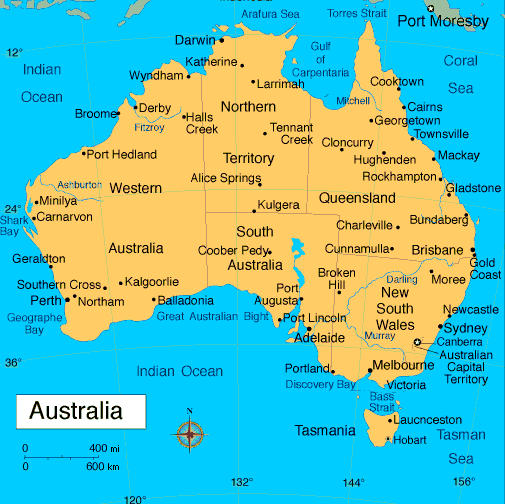
With the population boom in Australia, England carves up the map of Australia into states, each with a settlement, to be governed by a bicameral legislature under a Queen-appointed Governor. This was certainly not any suggestion of independence but it provided a safety-valve, and the English Parliament, after the American War, had ruled that England would no longer collect colonial taxes. |
| 1872 | In October 1872, the submarine cable from Indonesia provided the final telegraph link from London to Sydney. |
| 1880 | Fast steamships and ship refrigeration of meat (successful from 1879 on), revolutionized the pastoral industry and shipping as well, because ships now had a steady return cargo. |
| 1890 | Depression hit, the price of wool fell, and wages dropped further. The shearing union grew and grew strong, to battle once more for decent minimum conditions; but it lost, only this time it formed the Australian Labor Party and sent 2(?) members to the Federal Parliament. (abbreviated to ALP, which, under Hawke and Keating in the 1980s, came to mean the Anti-Labor Party).
Nonetheless, in the first 75 years, the ALP won for the workers a basic (minimum) wage, the dole for the unemployed, the vote for all men and women, and many other desperately needed conditions. |
| 1900 | Sailing ships, losing out on the Atlantic run, came instead to Australia. Here they began to lie idle 1895-1905; by 1910 wheat went to steamships, leaving only hardwood logs and coal with their poor profits. 1914 saw the end of the era.
Australia prepares for Federation in 1901 but this was not independence as most Australians believe. England and English banks maintained a tight grip on the throat of Australia for many more years. |