Gondwana
The beginning
Planet Earth, originally a swirling cloud of gas and dust, under gravity concentrated itself into a globe. As all its particles moved closer together gravity increased, pulling it tighter and tighter, and with this compression its temperature grew and grew, turning the compressed particles into molten rock. The less dense minerals floated to the surface. The least-dense formed molten continents floating on a slightly denser molten layer of skin (a bit like globules of oil floating on water).
As heat radiated from the Planet's surface, that surface cooled enough to solidify. Thus the lighter continents solidified first while floating on a denser layer as it too solidified. You can image how the lighter continents became trapped in and on the layer inderneath as that under-layer solidified. But while the skin loses heat to space, it provides insulation to the core, which, owing to radioactivity and compression under gravity, remains molten.
This thin fragile skin, only a few kilometres thick, is not strong enough to withstand the enormous forces from beneath, and has been torn intoMany irregular patches of all sizes, called Tectonic Plates.
The less dense patches of skin float as continents on the more dense skin, called Tectonic Plates. Between these lighter patches (continents), water has collected on the denser skin, forming oceans and seas, sufficiently deep as to cover the edges of the continents, known as continental shelves.
Tectonicmeans "relating to the building of something" or "relating to the structure of a planet's crust" or "relating to changes affecting it". A plate is something which has a large 'flat' surface (area) relative to its thickness.
Tectonic Plate Theory
Continental Drift or Tectonic Plate Theory is the principle that the continental landmasses have not remained in fixed positions, but have moved around the earth's surface apparently independently.
When two continental plates collide, one will slide under the other (subducts). The heavier plate will slide downwards into the molten rock beneath and itself melt. The other plate is pushed skywards forming high mountains prone to earthquake and volcanic activity. Such mountain ranges are the Andes, Himalayas, the European Alps now much eroded, New Guinea highlands, Indonesia. The Himalayas of Nepal and Tibet are being pushed skywards as the India Plate pushes against the Tibetan Plate and subducts under it. The Australia Plate pushes against New Guinea, forcing its land upwards. The Nazca Plate (Pacific Ocean) pushes eastward against South America, forming the Andes with its long line of volcanoes.
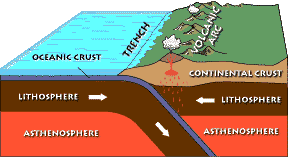
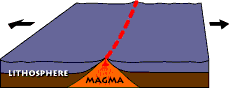
When two plates move apart, making a long crack in the Earth's crust, the molten rock from under the plates oozes up thru the crack. This occurs all the way down the mid-Atlantic Ocean, as the African Plate moves eastwards while the South American and North American Plates move westward. This crack can be seen above water-level in Iceland.
Where two plates slide alongside each other, their edges alternately gripping with friction then suddenly sliding, there is devastating earthquake activity whenever a slip occurs. This happens in California where the Pacific Plate slides alongside the North American Plate. The joinMakes a crack or fault, often very wide, which can be seen running under buildings. Such buildings will have one half moving southwards while the other moves northwards.
Altho scientists were very sceptical for the first 50 years of the 20th century, there are now over 10 different types of evidence which verify this phenomenon. Above all, the movements of the plates are being constantly meazured both on Earth and from the moon.
Continental drift and evolution
It is important in evolution because of the effects it has had on evolution and taxonomic diversity, brought about by the collision and moving apart of landmasses. The drifting apart of landMasses brings about vicariance, where organisms are split up by the development of barriers, isolating descendent populations which then evolve to form new taxa.
Continental drift theory explains why the plant species Nothofagus is restricted to the southern hemisphere, yet is dispersed across several continents separated by oceans, and its fossils exist beneath the frozen wasteland of Antarctica. Although there are significant morphological differences between the species of Nothofagus, they all have seeds seemingly poorly adapted for long range dispersal, and are also intolerant of immersion in salt water. Continental drift reconstruction explains that the southern continents were once united as a singleMassive continental landMass called Gondwanaland, and which had a much warmer climate than present-day Antarctica.
As continents moved, seabeds rose and sank, such that the limestone formed from calcium skeletons ofMarine protozoa, rose to form huge karsts in China thru to Malaysia and Indonesia, and limestone belts in England, the Nullarbor Plain and Tasmania. Marine fossils can be found on the highest of mountains, even the Himalayas and the Andes.
Rising mountains and changing watercourses brought isolation, leading to evolutionary dispersal. Colliding landmasses merged populations leading to competition. Both changes created new niches, awaiting those able to fill them. During stability, a population increases its genetic diversity such that some are better able to adapt to fresh environmental changes. The less-adaptable become extinct. Thus the changing climates and habitats encourage both diversity and extinction.
Early continents
Gondwana, originally called Gondwanaland, was a southern supercontinent that existed about 500 to 200Ma (million annum/years) ago. Gondwana included most of the landmasses in today's southern hemisphere, including Antarctica, South America, Africa, Madagascar, Australia-New Guinea, and New Zealand, as well as Arabia and the Indian subcontinent, which are now in the Northern Hemisphere. The name is derived from the Gondwana region of central northern India (from Sanskrit gondavana "forest of Gond").
Pangaea
Other large continentalMasses, including the cores of North America (Canadian Shield or Laurentia), Europe (Baltica), and Siberia were added over time to form the supercontinent Pangaea by Permian time.
Gondwana I + Laurentia (Canadian Shield) + Baltica (Europe) + Siberia ⇒ Pangaea
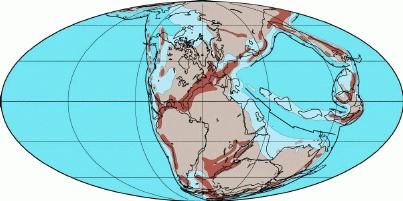
When Pangaea broke up (mostly during the Jurassic), two largeMasses, Gondwana and Laurasia, were formed.
Pangaea ⇒ Gondwana II + Laurasia
When Pangaea broke up, the re-formed Gondwana continent was not precisely the same as before Pangaea formed; for example, most of Florida and southern Georgia and Alabama are underlain by rocks that were originally part of Gondwana but that were left attached to North America when Pangaea broke apart.
Gondwana was formed by earlier landMasses colliding over hundreds of millions of years, to eventually form one temporary continent about 550-500 million years ago in the Cambrian (Period). The final stages of Gondwana assembly overlapped with the opening of the Iapetus Ocean between Laurentia and western Gondwana.
Climate
During the late Paleozoic, Gondwana extended from a point at or near the south pole to near the equator, yet much of Gondwana, the climate was mild. India contains about 3% of the world's coal reserves and much of the mined coal is derived from the late Paleozoic Gondwana sedimentary sequence. During the Mesozoic, the world was on average considerably warmer than today. Gondwana was then host to a huge variety of flora and fauna forMany millions of years. But there is strong evidence of glaciation during Carboniferous to Permian time, especially in South Africa.
Breakup
Mesozoic
Reconstruction showing final stages of assembly of Gondwana, 550Ma ago.
550-500Ma/Cambrian:
Gondwana was formed by earlier landMasses colliding over hundreds of millions of years, to eventually form one temporary continent about 550-500Ma in the Cambrian (Period).
Jurassic: When Pangaea broke up (mostly during the Jurassic), two largeMasses, Gondwana and Laurasia, were formed.
167Ma/mid-Jurassic: Gondwana began to break up in the mid-Jurassic (about 167Ma), , when East Gondwana, comprising Antarctica, Madagascar, India and Australia, began to separate from Africa.
130 - 110Ma: South America began to drift slowly westward from Africa as the South Atlantic Ocean opened, beginning about 130Ma during the Early Cretaceous, and resulting in openMarine conditions by 110Ma.
120Ma: East Gondwana itself began to be dismembered about 120 million years ago as India began to move northward.
80Ma - 40Ma: Australia began to separate from Antarctica perhaps 80Ma (Late Cretaceous), but sea-floor spreading between them became most active about 40Ma during the Eocene epoch of the Tertiary Period.
130-85Ma: New Zealand probably separated from Antarctica between 130 and 85Ma.
The Madagascar block, and a narrow remnant microcontinent presently occupied by the Seychelles Islands, were broken off India; elements of this breakup nearly coincide with the Cretaceous-Tertiary extinction event. The India-Madagascar-Seychelles separations appear to coincide with the eruption of the Deccan basalts.
55Ma/Cenozoic: As the age of Mammals got underway, the continent of Australia-New Guinea began gradually to separate and move north (55 million years ago), rotating about its axis to begin with, and thus retaining some connection with the remainder of Gondwana for about 10 million years.
45Ma: About 45Ma, the Indian Plate collided with Asia, buckling the crust and forming the Himalayas. At about the same time, the southernmost part of Australia (modern Tasmania) finally separated from Antarctica, letting ocean currents flow between the two continents for the first time. Cooler and drier climates developed on both continents because ocean currents enveloping Antarctica were no longer directed into the subtropics, where they would have flowed around northern Australia.
30Ma: Another significant world climatic event was South America separating from West Antarctica some time during the Oligocene, perhaps 30 million years ago. Immediately before this, South America and East Antarctica were not connected directly, but theMany microplates of the Antarctic Peninsula remained near southern South America acting as "stepping stones" allowing continued biological interchange and stopped oceanic current circulation.
But when Drake Passage opened, there was now no barrier to force the cold waters of the Southern Ocean north, to be exchanged with warmer tropical water. Instead, a cold circumpolar current developed and Antarctica became what it is today: a frigid continent that locks up much of the world's fresh water as ice. Sea temperatures dropped by almost 100C, and the global climate became much colder.
15Ma: By about 15Ma, the collision between New Guinea (on the leading edge of the Australian Plate) and the southwestern part of the Pacific Plate pushed up the New Guinea highlands, causing a rain shadow effect which drastically changed weather patterns in Australia, drying it out.
v
Later, South America was connected to North America via the Isthmus of Panama, cutting off a circulation of warm water and thereby creating the Arctic.
The Red Sea and East African Rift are examples of the widening 'cracks' in Gondwana.