Hominids
A hominid is a primate of the family Hominidae. The hominids have two genera (plural for genus), namely, Australopithecus and Homo, each having several species. The genus, Homo includes modern humans (Homo sapiens sapiens), early humans (Homo sapiens) and several fossil forms.

The story of hominids is vague and uncertain, open to interpretation and misinterpretation. Interpretation is influenced by philosophy and religious beliefs, which form unspoken premises.

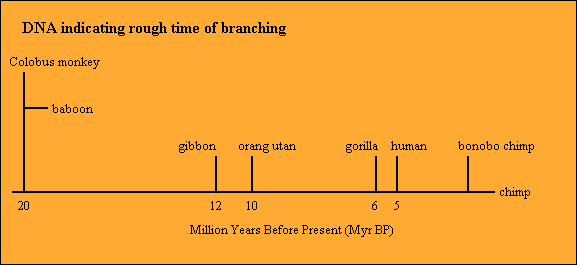
The first diagram uses genetic differences to gauge the path and timing of the evolution of the apes. It shows where the hominids (shown as 'human') branch out. Some 99% of the genes of gorillas, humans and chimpanzees, are shared;and, DNA-wise, chimpanzees are closer to us than they are to gorillas.


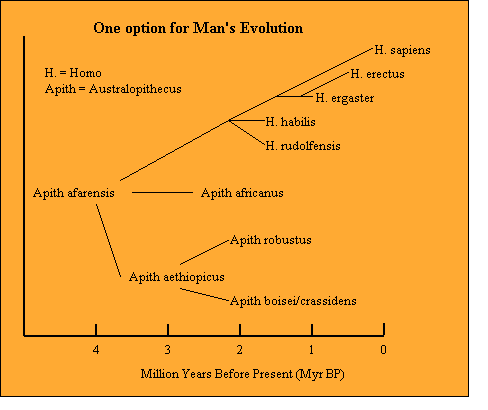
The diagram below, of the evolution of man, is but one of many alternate hypotheses. Every time an archaeologist finds a Hominid tooth, he claims to have revolutionized man's view of evolution. Obviously archaeology has a long way to go before there is enough evidence to accept one of these many hypotheses as a theory. [Will they smile when they find the spaceship that brought the first people to earth ?]

A. = Apith = genus Australopithecus.
H. = genus Homo.

Descriptions with accompanying hypothesis:
Another suggested lineage is:
A. afarensis > A. africanus > H. habilis > H. erectus > H. sapiens.

Different species of the same period appear to have lived near each other. Head size is directly correlated with climate (temperature) with small heads dissipating heat more rapidly in hot climates. Less than 35,000 years of habitation of America shows this same correlation, revealing how quickly skeletal structure responds to climate change.

One hypothesis is that Homo erectus migrated out of Africa and through Euro-Asia, before evolving into the different races of Homo sapiens, namely, Negroid, Caucasian, Mongol, etc, in response to climatic pressures. The opposing hypothesis is that, yes, Homo erectus did migrate out of Africa, but that Homo sapiens evolved in Africa from Homo erectus, then migrated out of Africa about 100,000 years ago, mingling with H. erectus but eventually displacing it.

Modern man has the species name:Homo sapiens sapiens. To avoid repetition, the custom is to name the genus once then abrreviate that genus name:Homo habilis, H. erectus, H. sapiens;Australopithecus anamensis, A. afarensis, A. africanus.

Ice ages, as explained by Milankovich, are related to:
Ice ages:
Definitions:
Upper Paleolithic: 40-10,000 BP, the last phase of the Stone Age. (Paleo- = old, prehistoric;-lithic = rock, stone;upper, as in lower, middle and upper layers of stone tools at one site - the upper layer is most recent.)
Clade: a group with a common ancestor.
Glade: a group with similar level of adaptation but not necessarily a common ancestor.

NameYears agoComment
Australopithecus5 MyrSouthern apes in central-southern Africa;split from chimpanzees 5x10⁶ years ago, branching into the Hominids. This coincided with great environmental change:
  • the closure of the Gibraltar Strait converting the Mediterranean into a Dead Sea and allowing movement between Africa and Europe
  • creation of desert, blocking the north-east corner of Africa
  • 6 - 5 Myr BP, savannahs created in East Africa, confining hominids to the tropics
  • general cooling fragmented forests, and spreading savannah (now 65% of all African vegetation, a 13000 km belt from Senegal to the Cape), affecting speciation such as new species, both carnivores and larger herbivores.
  • combined tectonic and climate activity in the Rift Valley caused intense fragmentation of habitats, with fewer arboreal habitats and greater distance between them
  • gorillas feed on shoots and leaves at ground level;chimpanzees on fruit, termites, etc, in trees, with an occasional monkey.
  • the need to cross savannah 'moats' with risk of predation, would have encouraged bipedalism
  • bipedalism reduced exposure to the equatorial sun and exposes greater surface area to breezes, particularly the neck, for the larger brain needed more cooling. This was aided by head and shoulder hair as a shield, and highly developed sweat glands for cooling.
  • such adaptations to heat enabled them to forage during the heat of the day when other animals were resting in the shade
  • The !Kung San of the Kalahari have shown that the best of them can run an antelope into the ground by combining tracking and running skills, showing that the bipedalism of a hominid can have advantages over quadrapedalism, in long distance travel.
  • predation and a changing environment would exert pressure on group size (for protection), physique and intelligence.
  • small intestine and large brain need efficient foods and thus more selective foraging
A. anamensis  
A. afarensis4 - 3 MyrDated absolutely from 3.7 Myr, including bipedal footprints of 2 adults and 1 child, but hands & feet still adapted to arboreal activity. Ancestor to H. habilis and A. africanus.
Might be a northern form of the gracile A. africanus.
A. africanus3 - 2 MyrSimilar to Homo rudolfensis and H. habilis. Gracile with jutting faces. Some treat all three as variations of one species, collectively named Homo sp. Earliest stone tools c. 2.5 Myr. Did A. africanus use stone tools ?
Homo habilis2.5 MyrDescended from the gracile A. africanus. Several offshoots evolved, but most became extinct. Evidence for 2.3 - 1.6 Myr. Lived alongside H. ergaster, H. rudolfensis, A. robustus, A. boisei. Perhaps 4 species of early Homo and 3 robust Apiths in southern and central (Ethiopian) Africa. Stone tools but no evidence of fires.
Homo erectus1.6 MyrFossils from 1.6 Myr;large brain + stone tools (have been around for 1 Myr before H. erectus), in Africa, Java & China. One archaeologist argues that H. erectus is not found in Africa, but evolved from H. habilis after it migrated out of Africa and into China and S.E.Asia. No evidence yet of fires. Brain size (850 - 1000 cm3) is at lower end of H. sapiens sapiens.
 1.5 - 1 MyrFirst evidence of use of fire. Burnt bones show > 5000C. This site had been used earlier by H. habilis and robust Apiths but without evidence of fire.
First migration900 - 800,000First appearance of Hominids (H. erectus) outside of sub-Saharan Africa, coinciding with faunal migrations such as lion and hyena. Was this a result of climatic changes which followed the ending of the Ice Age ? (There have been finds which may indicate an earlier exodus - but this has not been resolved.)
First migration extended700,000H. erectus reaches Europe.
 400,000by 400,000 H. erectus has evolved into early (archaic) H. sapiens.
Stone Age begins200,000There are fire, stone tools, primitive hearths
Ending of Ice Age103,000Climate becomes warmer. Ice Ages can develop in only a few years, in decades and fewer. The longer Ice Ages last for about 1000 years. Ice ages appear to run on 100,000 and 40,000 year cycles.
By 100,000 BP, Homo erectus had colonized all Africa and moved out into the Middle East
 90,000By 90,000 BP, Homo erectus had colonized through to India and China and was moving south into S.E.Asia.
Ending of Ice Age82,000Climate becomes warmer.
Ending of Ice Age60,000Climate becomes warmer. Homo sapiens; 'sapiens' means intelligent – whose kidding? Possible migration into Australia, requiring sea-craft for a 65 km crossing.
Origin of Homo sapiens
Modern man, Homo sapiens, began with its evolving out of Homo erectus. In the early period, both forms would have existed at the same time.

But where did this evolution occur ?

To trace human evolution, physical anthropologists have been providing conflicting answers for over a hundred years by studying morphological characteristics, such as skull shape, of the fossilised remains of our human and proto-human ancestors.
Now, mutations in human DNA are being used to show relationships through our evolutionary history.
Recently, comparing mitochondrial DNA of living humans of diverse origins has suggested evolutionary trees. Mutations occur in our DNA at a regular rate and will often be passed along to our children. (Mitochondrial DNA is more readily available and its mutations more reliable than nuclear DNA.) It is these differences (polymorphisms) that, on a genotypic level, make us all unique, and analysis of these differences will show how closely we are related. However, different approaches used by molecular and physical anthropologists have led to opposing views on how modern humans evolved.
Two main hypotheses
The two main hypotheses agree that Homo erectus evolved in Africa and spread to the rest of the world around 1 - 2 million years ago.
But where did modern man, Homo sapiens, originate ?
For this, there are two conflicting hypotheses: