bronze & money
Bronze 3200-2000BC
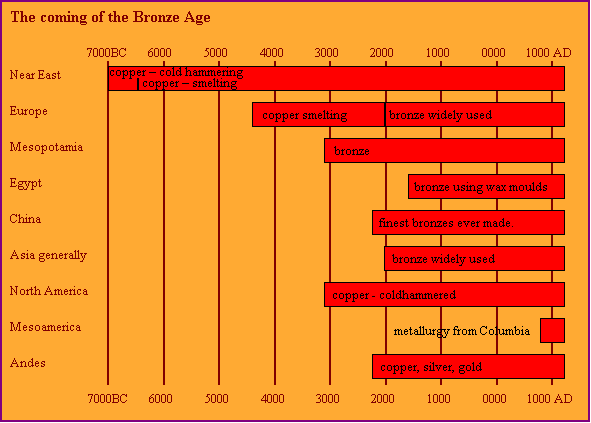 Some copper is pure enough to be malleable but mostly it occurs as an ore which can be smelted at 7500C. Copper melts at 11000C. Pottery was already being fired at temperatures well above this range. Impurities of other metals such as arsenic, strengthen the copper. When tin was added, bronze was formed, strong and hard enough for swords but too expensive for farm implements. The need for scarce tin called for long trade routes. The main source of tin for Europe was Cornwall, England, from pre-Roman times to the 1800s. In Asia the main source was the alluvial deposits in Malaysia, which also began supplying Europe from the 1800s on.
In 3200BC Mesopotamia produced bronze for prestige items and weaponry, and later Egypt did likewise; only the Indus used it for agricultural tools in the early period. In Egypt bronze tools did not become widespread till after 2450.
China developed bronze about 2200BC and developed the wax mould method of casting (also developed in the Americas and Mesopotamia). A wax model is made, covered in clay, inside and out, to make a leak-proof vessel, then the molten bronze is poured in, melting the wax which floats out the top. The Chinese thus made stunningly beautiful intricate ritual vessels.
Money & standardized meazurement 700-200BC
Although bartering is on the increase in the developed world to reduce over-taxation of the poor, bartering has great inconveniences - how far will I have to carry my sack of wheat before I find a knive-maker who just happens to want a sack of wheat? Will he pay as much as the baker? But then the baker will pay me in only bread. Will the knive-maker want that much bread when it goes mouldy quickly?
China invented money in the Zhou Period, post-1027BC. The Shang had used cowrie shells but the Zhou replaced these with miniature bronze knives in the 7th century and then with copper coins in the 4th century (with a central hole for threading onto a string). The Chinese used moulds up till the end of the ninteenth century AD whereas the early 'western' countries punched an upper die onto a circular peice of hot metal placed on a lower die. The Qin Dynasty 221-210BC standardized weights and lengths, including the lengths of axles on waggons to reduce the problems of ruts in roads.
The Greek kings of Asia Minor (west coast of Turkey) circulated uniformly weighted electrum (gold and silver alloy), and by 600BC, stamped them with their name and symbol to guarantee quality, so the coins no longer had to be weighed - merely counted. By 500BC Greek city-states were minting silver coins of precise weight.
Soon Indian rulers issued silver coins identified by punch marks.
By 200BC, coinage had spread to the areas of today's Spain and France.
Greek towns in southern Italy, for small local currency, issued bronze coins whose value was more than that of the metal, creating the risk of forgeries, but these had small local circulation.
Around 32 BC Alexander the Great issued multi-denominational coinage in gold, silver and bronze, influencing the spread of coinage through the Mediterranean and western Asia.
By 300AD, the Romans provided unified coinage even though they minted in several cities.
There are two approaches to coinage:
- the value is in the contents (gold, silver, copper):
- problem: fluctuating price of metal
- problem: cost of making coins - who supplies the gold and what do they get in return?
- the gold can end up in another country
1840AD, China was forced by England to allow the importation of opium and payment for it with silver, thus draining the country's reserves.
- the value is in the ruler's guarantee:
- problem: inflation devalues currency
- problem: ruler is overthrown, country is conquered (Germany 1918, Nationalist China 1945-49)
- ruler prints money to cover costs
- forgeries
Today, money is made from relatively low-cost metal and paper, and so has no intrinsic value (value of itself). Its value is partly set by the ruler and partly by demand. If the ruler mints heaps of money to cover government spending (as done by Hitler, Chiang Kai Shek), the value of the currency will drop (inflation).