Engines
This section assumes you know the Introduction well.
Types of engines
There are several types of engines:
- In-line engine
- V8 engine
- Horizontal-opposed engine
- Rotary engine
- Electric
In more detail, the types of engines are:
- In-line engine
The cylinders are in a straight row. There are usually 4 or 6 cylinders, in each of which is a piston connected to the crankshaft by, you've guessed it, by connecting rods (con rods). These con rods look nothing like rods, being H-shaped in their cross-section.
- V-engine
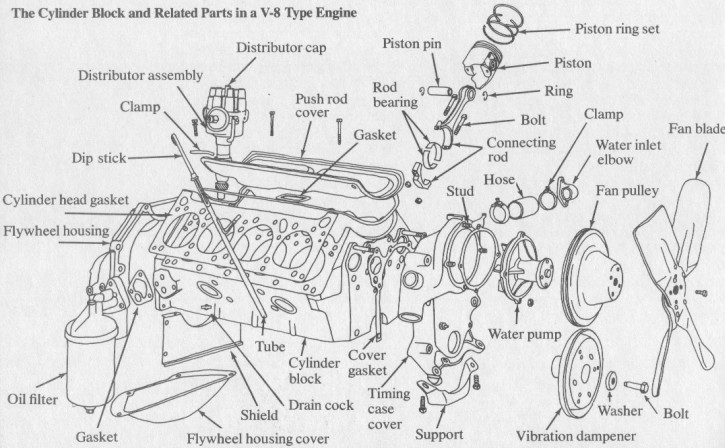
To shorten the length of the engine block, a row of alternate cylinders are aligned at right angles (900) the other row of alternate cylinders. (See diagram.) The cylinders usually number 8, but sometimes 6. Otherwize, it is the same in all functions as the in-line engine.
- Horizontal-opposed engine
All cylinders are horizontal. One row of alternate cylinders are set directly opposite to the other row (at 1800). The crankshaft lies between them. The BMW motorbike uses the horizontally-opposed engine with just 2 cylinders. Car engines use 4 or 6 cylinders.
- Rotary engine
This was the great invention by a Perth inventor who is now worth millions even though we have not yet seen his product. So we will not bother with it.
- Electric
These are short distance city cars, using a different sort of pollution but greatly restricted in distance. Again we will not bother with them.
Many petrol/gasoline/gas engines have been adapted to use LPG gas and others to ethanol. US buyers call petrol 'gas' whereas the rest of the world sensibly calls it petrol. Who knows what the US calls gas ?
Diesel engines can run on vegetable oil purchased cheaply from the fish-n-chip shops of 'western' societies. The treatment of such oil for fuel is easy and cheap.
Sections of an engine
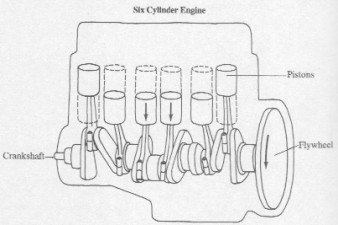
The engine comes in several sections:
- the rocker or tappet cover
At the very top, that thin metal cover where you pour the engine oil in. Look inside the cap to see the rocker arms. These push down on the inlet valves to open them to let fuel-air mix in, and down on the outlet valves to let the exhaust fumes out.
- the head
The solid cast iron or aluminium piece between the rocker cover on top and the thin head gasket underneath. This head gasket 'blows' occasionally, allowing gas from the cylinders to escape.
- the engine block
This holds:
- the cylinders
- the pistons, sitting on con rods, and sliding up and down inside the cylinders
- the crankshaft which rotates inside the bottom of the block, and pushed around by the con rods (and pistons)
- the camshaft which rotates to lift the push-rods which reach up to push the rockers on top of the head.
- sump
which holds most of the lubricating engine oil. With the wind blowing around the sump, it helps to cool the oil.
How does the engine work ?
These are the steps in sequence:
- You depress the accelerator pedal twice to turn over the little fuel pump.
- The fuel pump 'sucks' fuel from the fuel tank, filters the fuel and pushes it to the small fuel reservoir at the carburetor or carbie.
- You use the crankhandle or the starter motor (by turning the ignition switch passed 'on' to 'start') to turn the flywheel around.
- The flywheel is big and heavy. Once it begins turning, its momentum keeps the crankshaft and the camshaft turning over several times.
- The turning camshaft pushes push rods up to the rocker arms (under the rocker or tappet cover), and these rocker arms open and close the inlet and exhaust valves.
- The inlet valves on opening let in air; the pistons, as they are pulled down by the crankshaft, suck in air from the air cleaner, with fuel from the small fuel reservoir, through the carburetor. (See the inlet pipe from the carbie, feeding each cylinder.)
- The air cleaner, in a petrol engine, is a big flat cylinder with an air filter inside, sitting on the carburetor. The pistons, as they move downwards, suck air through the filter and through the carbie where it is mixed with fuel.
- The carburetor has a butterfly valve, called a 'choke' which, by partly closing off the air pipe, limits the amount of air. This enrichens the fuel-air mix for starting in cold weather. The carbie also has several fuel jets or holes, which control the amount of fuel injected into the passing air, according to whether the engine is being started, or the engine is slowing or accelerating. Surprisingly complicated, so that it all happens without our having to think about it.
- The fuel-air mix is 'sucked' along the cool inlet pipe, past the inlet valve, and into the cylinder as the piston moves downwards.
- As the piston moves upwards again, the inlet valve closes, the piston compresses and thereby heats the fuel mix. In a diesel, this becomes so hot that the fuel self-ignites. In a petrol engine, the fuel needs a spark to ignite. (More later.)
- As the piston reaches the top of the cylinder the fuel-air mix ignites, expanding as new gases are formed and heated. This expansion forces the piston down.
- The piston pushed the connecting or con ord which turns the crankshaft at the bottom of the engine.
- The turning crankshaft, when you put the vehicle 'into' gear, then turns the drive shaft, which turns your wheels.
- Meanwhile, the piston, after pushing the crankshaft around, is itself pushed upwards by the momentum of the crankshaft. The exhaust valve is pushed open by the rocker arm, allowing the piston to push out the burnt-fuel gases out into the hot exhaust pipe, into the muffler and out into the air for pedestrians to breathe.
- Then the piston is pulled downwards; the inlet valve opens and more fuel-air mix is sucked in. The piston goes down 2x and up 2x, to complete one cycle. These 4 strokes, make it a 4-stroke engine.
How does the ignition work ?
See the diagram of the ignition system.
Now we come to making that vital spark so desired for petrol and gas engines.
These are the steps in sequence:
- You turn the ignition switch. A red light comes on in the dash, telling you that the battery is now losing electron-flow or electricity.
- The battery sends electricity to the ignition coil which transforms it from 12 volts to thousands of volts, before passing it to the distributor.
- As the engine turns, it turns the distributor - note how it fits on the side of the engine block.
- Inside the distributor a rotor opens and closes 2 contacts, accurately. When the contacts close, allowing electrons to pass to a specific lead (from the distributor cap) and onto a specific spark plug.
- These leads from the distributor are connected to the spark plugs in a specific order. Do not change the order because the cylinders must fire in a particular sequence. Label leads before removing them from the plugs. While the rotor goes around charging the leads in squence, the leads do NOT go along the spark plugs in the same sequence. See manual for firing order for cylinders. Number one cylinder is at the front, on the same end as the timing chain cover.
- The spark plug is charged and sparks when the piston reaches the top of its compression stroke. This must be prefectly timed and executed, with the many parts working cleanly. Not surprising then that the electrics cause the most problems. See the chapters Wont start and Ignition trouble.