Trouble
There are 3 types of vehicle trouble:
- electrics
- mechanical
- body (etc)
Problems soon sort themselves into those we can see and those we cannot see. Problems we cannot see require a disciplined systematic process of elimination of possible causes. Car mechanics is the best training ground for clear thinking; the same thinking that produces good mathematicians and scientists.
Here are the steps to follow:
- List the symptoms
- Sort and group the symptoms
(Caution: they may be unrelated and stem from different problems)
- List the possible causes
of each set of symptoms
- Test each possible cause
starting with the cheapest/quickest test and working through to the most costly.
- Eliminate each possibility till the real cause is found and proved.
How do we list the symptoms ?
We drive with our eyes, ears and nose.
A friend, Bob, was driving his car with a heavy passenger, which is just as well. They pulled up at the traffic lights and were surprised to see a good wheel and tire roll past them. Ignoring the red light, the wheel crossed the junction and rolled on down the road. While waiting for a change from red to green Bob and his friend pondered on this curiosity, particularly since there were no other cars behind them. A profound discussion with his passenger, brought Bob to the very sound conclusion that since his was the only car around, it might just be his rear wheel.
It was.
When I had been a passenger a few days before I had mentioned that there was a noise in the back that sounded like a loose wheel, but Bob retorted "Dont be silly!" so I let it pass. Bob does not drive with his ears. I know of 3 similar instances, and this failure to hear obvious noises may be due to people driving with their radio on.
Two weeks later I mentioned to Bob that I could smell kerosene. "Dont be silly!" he laughed. A few days later, when he opened the boot, he found a tin of kerosene had leaked over everything. Bob does not drive with his nose.
Bob says I am a jinks. Now he doesn't let me say anything while in his car.
Drive with your nose. Smell for a heated engine, burning oil or rubber. Can you smell exhaust fumes inside the cabin ? (This risks acute carbon monoxide poisoning, sleepiness, and other health risks.)
Drive with your eyes. Watch your temperature gauge - do not wait for red lights on the dash board since these come on long after damage has begun.
Cleaning the car enables you to find loose nuts and bolts, scratches waiting to rust, and oil and water spots on the ground from leaks.
While checking the oil and water when you buy fuel, check the battery level and terminal corrosion, oil leaks, hoses and their connections, electrical connections, lights, and so on. With practice, inspection takes only seconds. Catch problems early before they become serious. Does the exhaust blow blue smoke, black smoke ?
Listen to the engine. Does it sound differently lately ? Are there any unusual pings, knocks, taps ? Are they regular or intermittent ? Is the engine hunting (going faster then slower then faster). Does the engine sputter or backfire occasionally ? Does the engine continue firing after it has been switched off ? (Pre-ignition)
Above all, if something is unusual, take action to remedy it ! Many an engine has been damaged because the owner saw the red light on the dash board and thought that since the car was still going, he could drive it home to look at the problem there. (When I was a teenager, I was given a lift by a travelling salesman who did not know why the red light on his dash board, had lit up. He was happily intent on driving a further 300 km through the bush - dinkum !)
After having determined as many symptoms as possible, go to the checklist to see the likely causes of this set of symptomds. There are probably many causes.
For each possible cause, do one of 4 actions:
- remove or cure the possible cause if easy and cheap
- eliminate all other possible causes first, if this one is expensive or difficult to cure
- decide what other symptoms this cause will produce and look for those to confirm or deny it as a cause.
- when all these fail, look for 2 or more causes.
- when all these fail, suspect intermittent interference.
There are problems because sometimes the causes are intermittent. For example, my engine started easily when cold, ran nicely for about 20 minutes then stalled and would not restart till it had rested for about an hour. What do you think the problem was ?
Most trouble comes from the electrics.
(For bush work, this is a good reason to switch to diesel with manual gears and a crank-handle attachment on the front-end of the crankshaft.)
Caution 1:
- Remove wedding and other rings to avoid short-circuiting the battery and burning off a finger.
- Replace loose clothing and ties which can get caught in the fan-belt, strangling you or pulling your arms or face into the fan. A large-horsepower engine is far more powerful than us and can maim and kill us.
- Tie loose hair up or cover with a hairnet or showercap.
- Remove necklaces, lucky charms.
- Wear boots (if available) instead of thongs/flip-flops or loose sandals.
- Suggestions given in the next section, assume you have studied Science/Physics/Electricity and therefore know what precautions to take.
Caution 2:
- Never use a loose-fitting spanner.
This removes the corners on the nut, making it difficult to remove. Also risks injury. (One reported case of a boat being blown up - figure that one out ! The spanner slipped off the nut, hit the battery terminals, sparked and ignited the oil/fuel mix in the tray in the bilge.)
In desperate circumstances, correct a loose spanner by inserting a coin between the nut and spanner (but don't tell anyone I told you !)
- Never push a spanner
It is much more likely to slip off the nut. If it does, the skin on your fingers will be cut to the flesh, and perhaps your tendons damaged.
If you must push, then open your fingers completely straight. Try it to see what I mean.
- A spanner must be used correctly.
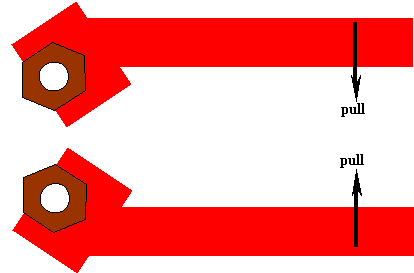
There is a right and a wrong way to hold the spanner. The wrong way causes the spanner to slip off the nut. Note the angle between the head and the handle. The obtuse angle is on the side of the direction of the pull. The reflex angle is on the other side.
- Tools are designed for safety.
People are designed for trouble. Always check your tools are safe to use, with no broken parts or frayed electrical cords. Then use the tools the way they are designed to be used. When all else fails, follow the instructions.
On a house-building job, I was up a ladder and glanced down at a fellow-worker who was picking up a hand-operated circular-saw. As he stooped to cut the floor boards, I could see what was going to happen. I called out but the noise of the saw drowned my call. As I clambered down the ladder, he dug the blade into the floorboard and it ran backwards over the electric cable, cutting through the insulation, throwing sparks in a huge swathe. He dropped the saw before being electrocuted, but it was close. He cursed the saw, saying it was jinxed and he would never use it again. But the whole episode had been obvious before it happened.
A few days earlier, his friend was using a bandsaw. His young daughter watched how he was operating, then said to her younger sister, "Daddy shouldn't be doing that; it's dangerous." The next moment Daddy's thumb lay on the floor. Always question the way you operate.
- Never do dangerous work when you are tired.
Tiredness reduces concentration and safety awareness. When working 20-hour shifts for weeks on end, I nearly lost my hand in a bandsaw and twice nearly killed myself doing electrical work. So now there are many jobs I never do when tired: electrical work, electric saws, machinery, up ladders.