Wont start

Electrical & fuel trouble

Most trouble comes from the electrics.

For bush work, avoiding electrical problems is a good reason to switch to diesel. Diesel uses electrics only to: The diesel engine compresses the fuel causing the temperature to rise to ignition temperature.
Add to diesel, manual gears because automatic transmissions in the bush reduce your options for self-help. Add a crank-handle attachment on the front-end of the crankshaft because starter motors require big currents and drain the battery in minutes. A crank handle avoids this, and also proves useful for winding a vehicle out of a bog.
To crank out of a bog, for a petrol engine, crack open the spark plugs to avoid the work of compression, put in 1st or reverse gear, and simply crank the vehicle out of the bog. I have never used this technique with a diesel but you may have to crack open the injectors because of the high compression which diesels use. Marine Volvo penta diesel engines have decompression levers but I do not know if any truck diesels do.
Reducing the tire pressure to give more surface area, helps too, although tubeless tires risk breaking the seal and then be impossible to inflate by handpump, with a vehecile sitting on top. When doing bush work, I always put tubes inside my tubeless tires, for this reason.

Caution 1:
Suggestions given in this section, assume you have studied Science/Physics/Electricity and therefore know what precautions to take.

Caution 2:
If engine turns over but car does not start, do not keep turning the engine over. This causes:
If the vehicle is difficult to start each day, the running of the vehicle may not be enough to recharge the battery. Eventually the battery will become discharged or flat.

Running the vehicle only at night when the headlights drain the battery will also lead to a flat battery.

Otherwise the alternator should be more than sufficient to keep the battery charged. If it fails to do this, check:
Possible causeSolution
Engine does not turn over.No electricity to starter motor.
Gear is not in 'Park' or 'Neutral'. The seat belt might need to be fastened.With automatic transmission, the gearstick must be in 'Park' or 'Neutral'. In some modern cars, the seat belt must be fastened.
There is an electric cable bolted to the side of the engine block.Clean and tighten this electrical connection.
The battery leads may look fixed in place but may need cleaning or tapping down and tightening.Remove lead; clean with hot water, then tap down and tighten. Use correct sized spanner to avoid ruining nut and bolt.
Battery is 'dead' or 'flat', without charge. Use these steps in order:
Use jumper leads from another car to start car. Connect (+) to (+) first; then (−) to (−). When finished, remove (−) connection first. Run engine in other car, at high revs:
  • If successful, the battery is the problem.
    Check:
    • Is the battery flat ? Use the booster to check for a good spark across the terminals (dangerous! Do not hold any uninsulated conductor between the battery terminals. Use a glancing blow otherwize the metal will weld to the terminal and you are in big trouble! Any petrol fumes may ignite/explode. Do you really want to use this crude method ? Use a voltmeter.)
    • Check the leads and connections; clean and tighten.
    • Did you leave the headlights on when not driving ?
    • Is alternator failing to charge battery ?
    • Is the electrolyte up to the required level ? About level with the split-rings you can see through the holes. If not, add distilled water or clean rainwater. Tap water usually contains salts which will shorten the life of the battery. Do not add sulfuric acid
    • Recharge the battery. 10 volts is 'flat'; 12 volts is OK; 15 volts is maximum charge. Less than 11 volts can shorten the life of your battery. When charging, disconnect the battery to avoid damaging your alternator. A hydrometer reading should be between 1.250 and 1.295, compared to pure water at 1.000. Less than 1.225 is poor, and indicates a desperate need to recharge the battery.
    • If battery fails to recharge, replace it. A battery usually does not last more than 4 years.
    A faulty alternator would not stop the engine starting but would explain why the battery is flat or discharged. While the old dynamos did not keep the charge up to the batteries so they needed recharging occasionally, today's alternators are so efficient, that they provide all electron-flow for running the car plus headlights, radio, and so on, and have plenty in surplus to charge the battery if it needs it. Provided all driving is not done with massive headlamps on, the alternator should keep the battery fully charged. Therefore a discharged battery suggests a faulty recharging circuit:
    • Loose, 'glazed' (shiny), or broken fan belt
      Looseness or a shiny belt lacks grip, allowing the belt to slip instead of turning the alternator. Always carry a spare new fan belt. A fan belt can be tightened but you will need to use a lever between the alternator and the engine block. A hefty screwdriver or tire lever will do. Holding the lever tight while tightening the nut, can be a challenge.
    • Loose or dirty electrical connections
      Treat as above.
    • Faulty battery
      Treat as above.
    • Sticky voltage regulator
      Use the manual to find the regulator. Tap the cover lightly with your small ball peen hammer (without breaking the cover) in the hope of jarring and thus separating the tiny contacts inside. If the tapping succeeds as indicated by the red light going out if the engine is running, then remove the cover and clean the contact points with a nail file or emery board. Avoid pressure on the abrasive; 2 or 3 passes is enough to remove any corrosion.
    • Faulty alternator
      While electron-flow is going out from the battery, a red light should glow on the dash board, with an adjacent icon telling you the battery is not charging (being charged). This red light comes on every time you turn the ignition key to on. It should go out soon after the engine starts. (The oil pressure light should do the same.)
      If all else is sound, leaving only the alternator, remove and open, look and smell. You might be able to see burnt wiring or smell it. If not, take it to a vehicle electrician to inspect. If it has failed, buy a good second-hand one from a crashed car.
  • If engine still fails to turn over, the battery is not the problem (or not the only problem).
    Check:
    • Check leads and connections in the starter circuit. (See the starter circuit below.)
    • Is ignition switch faulty?
      Test by short-circuiting the switch. This is called 'hot-wiring' it. Study the diagram above. Thieves hot-wire under the dashboard but you can hot-wire under the bonnet. If the engine starts, adjust or replace the switch.
    • Is starter solenoid faulty ?
      Always begin by cleaning and tightening electrical connections. Bypass the solenoid in very short burst - be careful. If starter works then solenoid is the problem. Repair/replace.
    • Is starter motor faulty ?
      Ensure the bolts are tight because mis-alignment may bind the a starter drive, that is, lock it so tightly it cannot move. Bypass all other circuitry - be careful, for the electron-flow is about 200 amperes. If you use a good battery directly connected to the starter motor, bypassing everything else, and it still does not work, then either the starter motor is faulty or the engine has seized. (You cannot sieze an engine without knowing about it.) Take the starter motor off and test its internal electrics. A professional mechanic can check for a bent armature. Repair/replace.
  • If engine turns over slowly but fails to start, there may be 2 problems: the battery and a problem examined in the next section.
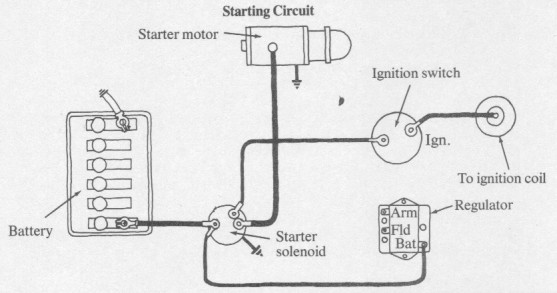
Engine turns over slowly but won't start.Poor electricity to starter motor.
Ignition switchOK
SolenoidOK
Battery connectionsCheck for poor battery connections. See section above.
Battery chargeCheck battery charge. See section above.
Starter motorTighten bolts to engine block, to correct any mis-aligment, which would bind/stop the motor. Starter motor may be partly defective. See previous section.
Engine turns over quickly but does not start.Fuel not igniting:
Either spark plugs not sparking
or fuel mix not correct.
Which problem do we test first ?Choose:
  • Fuel in the tank.
  • Correct type of fuel.
    Lead Replacement Fuel or Unleaded or 2-stroke or, heaven forbid, diesel ? This is a risk when using unmarked jerry cans. In a 2-stroke motor, too much or too little oil added by the driver, to the petrol, may prevent starting.
  • The carburetor choke
    A cold engine may need a richer fuel mix, that is, a lower proportion of oxygen (air). Ait intake is limited by the carburetor choke, a flap in the intake throat. Partially closing it reduces air flow; enriches the fuel + oxygen mix, and encourages quicker starting. Most vehicles appreciate the accelerator pedal being depressed twice by starting. But more than that and you risk flooding the engine.
    Too much choke, that is, too much restriction of oxygen intake, and there is not enough air to ignite the fuel. This causes 'flooding', that is, the cylinders are so full of fuel vapor that air cannot get in. This can sometimes be recognized by a smell of fuel.
    Try pushing the accelerator pedal to the floor and turning the engine. If the engine still does not start, remove the air cleaner from above the carburetor (by removing the small wingnut). Remove the lid. Use a screwdriver to open the choke (butterfly valve). Try starting the engine. Keep your face away from above the carbie until the engine has started. Then replace the lid to the air cleaner.
    Or do what we lazy people do - just wait patiently for the fuel to percolate down the sides of the piston, away from the combustion chamber. Then try again with the accelerator pedal on the floor.
    So, too little choke or too much choke will prevent your engine from starting. This is why many cars now have automatic chokes, keeping the control away from the driver. However, automatic chokes, with age, can become unreliable; and may need adjusting.
  • Ask the owner about similar problems in the past; the owner's experience can save a lot of time.
  • What did the vehicle do on the last trip ? Crossing swollen creeks probably wet the electrics. Filling the fuel tank in the rain probably put rain into the fuel tank. Refuelling from a rusty jerry-can might have added rust to the fuel and this blocked the filter or carbie. Driving through potholes filled with bulldust, may have choked the air cleaner.
  • Otherwize do the quick tests first, which may require hopping between testing for electrical fault and testing for fuel problem. (However, here we will list fuel and spark tests separately.)
Yet another caution: If, when testing the fuel line, you spill petrol onto the engine or ground, any electrical testing after that, may set you on fire. Test the fuel-lines by placing the end of the fuel-line into a container to catch the fuel. Spilling petrol on a hot engine, might also cause an explosion. Beware of onlookers who smoke. Avoid flammable clothing. Polyester and nylon clothing, when alight, shrink onto the skin and are impossible to peel off. If your shirt catches alight do not pull it off over your head - burning polyester will melt your face and you may never see it again. Think safety.
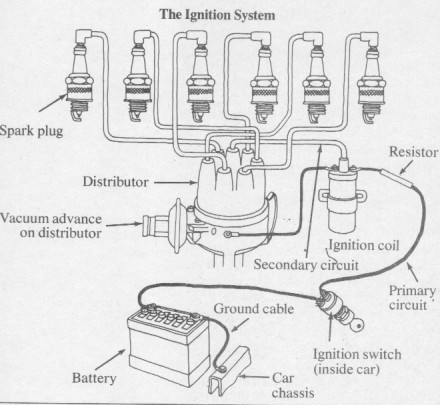
Testing for spark.Remove a spark plug and re-insert into its lead. Hold the electrode of the plug against the engine block.(Protect yourself from shock by using a clean dry rag.) Turn the engine over. The spark should be clear, strong, bright and blue. If so, move to fuel problem. If not, go to next step.
Distributor points may be burned or not set properly.File points clean; set points' gap (see manual for gap).
Distributor condenser may have a short (charge is passing across 'plates')Test; replace.
Ignition coil may be faulty.
Check by either:
  • substituting the good coil you always keep in reserve in your boot, and testing in place, or
  • having a professional mechanic test it.
If faulty, then replace the ignition coil.
Testing for fuelTrace the problem from the tank to the cylinder.
A hot engine can ignite spilled fuel or
its vapor.
 
Fuel in tankIs there enough fuel ?
If this problem occurred suddenly, this is the most likely cause. Other problems tend to come on gradually, although not always. Avoid running the fuel tank dry in wet climates, since a tank full of moist air can experience condensation when the temperature changes from hot to cold. Diesels usually have a good water filter which should be drained occasionally.
Air blockageIf you have let the fuel tank run dry, you might now have air in the fuel line. This may need removing. This is a common problem with diesels if the fuel pump is not self-bleeding. Even if they are, you might need to pressurise the fuel tank or use the manual lever and bleed screw on the filter. (See manual)
Fuel line to fuel pump.If the line runs too close the engine it can become heated, causing evaporation of fuel into pockets of gas which prevent the even flow of fuel. The fuel pump, with a glass cover which allows you to see the fuel, has a lever for hand operation. If you think the line is blocked, you can remove the line on the engine side of the pump, and operate the lever to see the fuel flow out of the pump. (Do not smoke. ;)
Fuel pumpIs it full ? Use hand lever to check pumping ability. A properly-equipped mechanic has tools to test fuel-pump volume and its pressure. (As for fuel line. You could kick the engine over to test the pump, but with fuel spilling out of the line, a loose spark or a hot engine might ignite the fuel. Think carefully about your safety.)
Fuel line from pump to filter to carburetor.Same as for fuel line. If fuel filter is not clean, clean or replace it.
CarburetorChoices:
  • Is the choke jammed ?
    Free it by opening with a screwdriver. Check the choke linkage to ensure it is not worn or jammed.
  • Does the carbie need adjusting ?
    There are 2 screws; see manual. Know what you are doing. Playing with these screws can upset everything and be difficult for a novice to put right.
  • Are any carbie jets blocked with dust ?
    Do not use any instruments, metal or plastic, to clear them. Metal will enlarge the hole; plastic will break and block it. Use clean compressed air only. Carbie must be spotless before putting back, so that dirt does not enter cylinders. Wipe engine parts with only a clean lint-free cloth.

Possible causeSolution
Thick oilIn cold weather the engine may have difficulty turning over with thick engine oil. Switch to winter-grade oil. And change the oil-filter.
Moisture in electricsPerhaps from driving through swollen creeks or hitting a pool of water at speed. You can try mopping away excess water with newspaper, clean cloth, and so on. Or spray with WD40, or similar fine oil used to overcome rusted nuts. Or wait for the warmth of the engine to evaporate the water.
Start the engine by pressing the accelerator pedal to the floor, to allow more air to enter the engine. Do not pump the pedal, which floods the engine with fuel. If it still does not start, wipe the plugs, wires and distributor cap again. Then try to start as before.
MufflerEngines are designed to work with a specific back-pressure from the exhaust. If you have a vertical muffler, and shorten or lengthen it, this alters the back-pressure and may prevent correct running of the engine. The loss of a horizontal muffler will also alter the back-pressure.
Faulty gasketDifficulty starting and loss of engine power, suggests a leaking head gasket.
Between the engine block and the head sitting on top of it, is a gasket designed to stop the hot burning gases from escaping from the cylinders. If this gasket 'blows', these gases escape, pressure drops and the pistons are not being pushed hard enough to turn the motor efficiently. There is a pressure gauge specifically designed for measuring pressure in the cylinders to determine if the gasket is blown and near which cylinders.
If you cannot afford this pressure gauge, listen for gas escaping from the head or from cylinder to cylinder. Check the sump oil for water droplets. Sometimes a faulty gasket allows the water from the cooling system to enter the cylinders and run down into the sump. This causes the oil to lighten in color, brown to green, black to grey, depending on how long the oil has been used.
If you are still not convinced you can carefully remove the head, trying not to damage the gasket, a difficult task. Removing and replacing the head is tedious, especially if it proves unnecessary. Doing this job does NOT require removing the rocker arms, but it does require a strict procedure to avoid distorting the head permanently. Not for the faint-hearted. A new gasket probably costs more than the pressure gauge just mentioned, so why not save both problems by buying it ?