Reading music

Naming notes

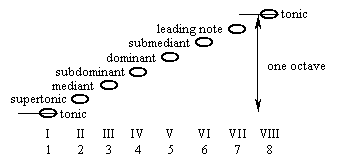
To aid our discussion we need to name each note of an octave.
octave01.gif not found
Sorry about the funny letters but musicians use them. The I = 1 and the V = 5.
So II = 1 + 1 = 2
III = 1 + 1 + 1 = 3.
IV = 5 - 1 = 4
VI = 5 + 1 = 6
VII = 5 + 1 + 1 = 7
VIII = 5 + 1 + 1 + 1 = 8
Fortunately the Muslims taught us how to write numbers efficiently: 0, 1, 2, 3, ..., 10, 11, ....

Going to the names of notes in a scale, learn:

Enharmonics

On a keyboard the black key to the right of C, is both C-sharp (C#) and D-flat (Db).
The same applies to all instruments.
D# = Eb
E# = F
F# = Gb
G# = Ab
A# = Bb
B# = C
B = Cb
E = Fb
C = Dbb
and on and on.
Different names of the same note, are said to be enharmonically equivalent (or just enharmonic notes).

Note design


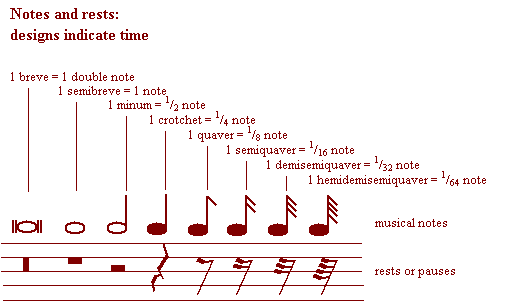
A dot placed immediately after any note increases its length by half as much again.
A bowed line joining 2 or more notes, indicates they are 'tied', that is, played or sung without separation.

Key signature

The word key means:
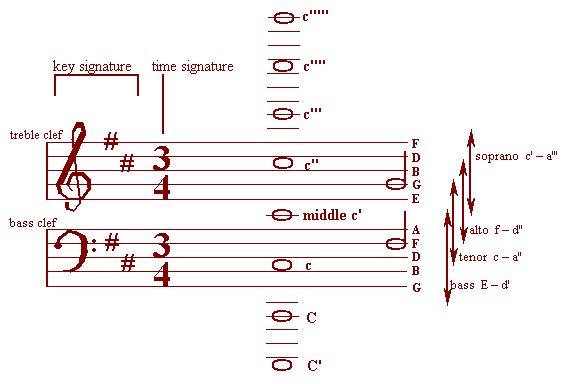
The notes are written on a group of 5 lines, called a staff (pronounced stave or staff). A clef is written at the beginning of each staff to indicate what key it is in.

not found
The c notes are illustrated on the piano in the chapter References/Instrument ranges
Each set of 5 lines is called a staff.
The key signature is the type of clef plus the sharps or flats.
The word clef is French for key.

Clefs are:
Bass is pronounced base, bay-s.
The treble and bass clefs are the common ones.

At the beginning of each set of music lines, called a staff, there is a gross symbol called a clef. The treble clef for high voices, indicates the G-note above middle C, while the bass clef for low voices, indicates the F-note below middle C; the alto clef for middle voices (altos) indicates middle C. Alongside these clefs are shown any sharps or flats in the scale, if any. The key signature is the clef grouped with any sharps or flats; called key signature, since they tell us which key or scale the music is in. We have either sharps or flats; never both in the key signature.

A sharp on F, placed in the key signature, means that every F is to be played as F#, that is, one semitone above F, unless altered on the lines with a sign for natural or a sign for flat. A sharp on other notes indicates the same for those notes.

A flat on B, placed in the key signature, means that every B is to be played as B#, that is, one semitone below B, unless altered on the lines with a sign for natural or a sign for sharp. A flat on other notes indicates the same for those notes.

Time signature

See the last diagram (above).

not found

A bar is indicated on a staff, being the notes within each pair of consecutive vertical lines.
The lower number in the time signature states the basic unit of time in a bar. The number '4' indicates a 1/4 note or crotchet. So 2 for minum, 4 for a crotchet and 8 for a quaver.
The upper number states the number of beats to the bar. Thus 4/4 time means 4 beats in each bar, each beat being one crotchet in time length. The first beat in each bar is strong or emphasized, and the others are weak. If there are 4 beats in a bar, the 1st is strong, the 3rd is less strong than the 1st, while the 2nd and 4th are weak.

What does 'strong' mean ?
A beat can be made strong by increasing the loudness of the instrument, or using more instruments to reinforce each other, or the note length may be lengthened slightly while the others are shortened (in spite of what the music reads) such that the whole bar takes the same amount of time.

Duple time can be any of 2/1, 2/2, 2/3, 2/4, 2/8 time and so on, all having 2 beats to the bar, whatever the unit of time. Further, a 2/2 bar having 2 beats with 2 half-notes or minums, can have those minums split into crotchets and/or quavers, and/or hemidemisemiquavers, as long as there are 2 beats. Several notes will then be run together to achieve the 2-beat requirement.

Some 'western' examples of 2/4 time, are Yankee Doodle, Jingle Bells, Joy to the World.
Cut time or 2/2 time, includes the Beatles' Cant Buy Me Love, Dr Robert, Eleanor Rigby, Get Back, A Hard Day's Night, I Call Your Name, ....

Triple time includes 3/1, 3/2, 3/3, 3/4, and so on. The favorites are the waltzes and minuets.
Examples: The Beatles' Lucy in the Sky with Diamonds, Norwegian Wood.

Quadruple time, or double duple time, includes 4/1, 4/2, 4/3, 4/4, 4/8 and so on. The most common is 4/4 time. The 1st beat is strong, the 3rd is less strong than the 1st, while the 2nd and 4th are weak.
Examples: The Beatles' All You need is Love, Happiness is a Warm Gun, Hello Goodbye, Hey Jude, I am the Walrus, ....


C time is 4/4 time.

C with a vertical line, is cut time of 2/2. Cut time is a fast version of C time.

The composer delights the listener by breaking all these rules through varying the stress.

Incomplete first bar
If the first or opening bar is incomplete, the last bar should supply the missing time value, thus completing the symmetry of the whole piece. the opening 'upbeat' completes the time value of the last bar.

Compound time
If the numerator is a multiple of 3, then this is compound time:
4/4 - count: 1, 2, 3, 4, 1, 2, 3, 4, 1, 2 .... with stress on the '1'.
6/8 - count: 1 and a 2 and a 1 and a 2 and a 1 and a 2 and a .... with stress on both 1, 2.

Asymmetric time
Asymmetric time, as in 5/4, 5/8, 5/16, 7/4, 7/8 time, occurs when the number of beats within a bar is 5 or 7. This combines duple and triple time, as in 3+2=5, 2+3=5, 4+3=7, 3+4=7, 2+3+2=7.
The inner stress changes according to the combinations.
These are found in folk music in central and east Europe and Asia, such as Hungary, Bulgaria and Russia. Bartok and Stravinsky often used them.

Syncopation

Syncopation is the varying of stress by accenting the normally weak beat instead of the strong beat. This creates tension and excitement. Crucial in jazz, syncopation can be found in classical and other works.
The 4 common ways of syncopating are:

Tempo

Tempo is the variations in speed. These variations are marked on the staff, usually in Italian.

TempoTranslationTempoTranslation
gravevery slowmoderatomoderate
lentoslowallegrettofairly fast
largobroadlyallegrofast
larghettorather broadlyvivacelively
adagioleisurelyprestovery fast
andantemoderate walking speedprestissimofast as possible

Because the above words are vague and can only be learnt slowly from experience, composers use metronome indicators. Example: crotchet = 160, meaning 160 crotchets to the minute.

Dynamics

The range in amplitude or loudness is usually abbreviated and written under the staff:

AbbrevItalianEnglish
fffmolto fortissimoextremely loud
fffortissimovery loud
fforteloud
mfmezzo fortefairly loud
mpmezzo pianofairly soft
ppianosoft
pppianissimovery soft
pppmolto pianissimoextremely soft

Usually signs, like the wedge-shaped greater-than or less-than signs, indicate gradual increasing and decreasing loudness, but (sub.) indicates 'suddenly', piu 'more', meno 'less'.
The slur under or over 2 or more notes, tells us to play the notes as legato, as one unit, smoothly together.

Different notation


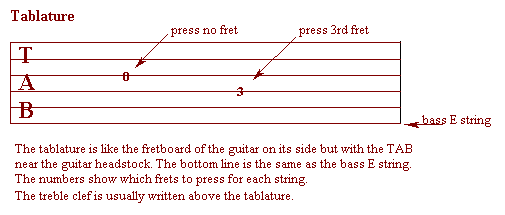
Tablature


Fretbox
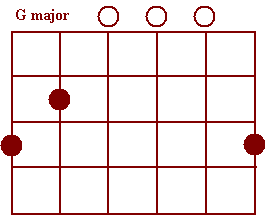
The fretbox shows a limited number of frets on the guitar fretboard, in order to show which strings are being depressed to give the required chord. The vertical lines represent the 6 strings of the guitar, with the top horizontal line giving the fret on the end towards the head (the part which tightens the strings). Strings which are not depressed, are usually shown with open circles above the fretbox.


Chord charts


Repeat notation


Classical notation

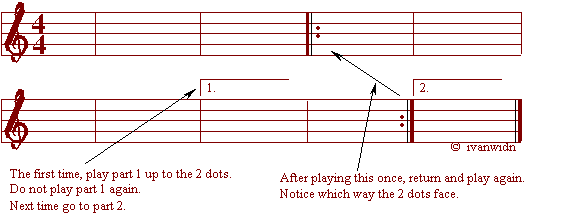
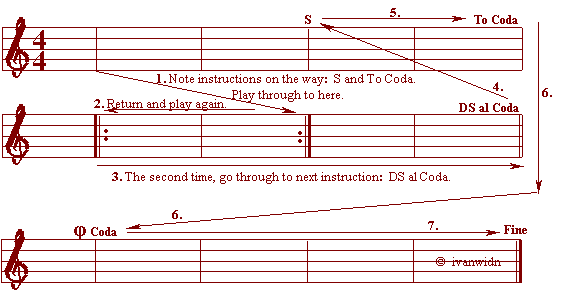
The repeat notation is similar in classical notation. We need to understand the meanings of the words used.

AbbreviationLatin nameMeaning
DDa, DalFrom the.
CCapoThe beginning of the whole piece.
SSegnoSign. Come here from DS al Coda.
AlAlGo to (or) get ready to go to.
ΦphiThis is just a Greek letter I have used because I do not have musical symbols.
DCDa CapoFrom the beginning of the whole piece.
DSDal SegnoFrom the S sign.
Al Coda ΦAl Coda ΦGo to the Coda, designated by Φ.
Φ Coda(Sign) codaCome here from the sign: Al Coda Φ.
DC al CodaDa Capo Al CodaGo to the beginning; play from the S sign till the first Coda Φ sign, then jump to the Φ Coda sign.
DS al CodaDa Segno Al CodaReturn to the S sign; play from the S sign till the Al Coda sign.


We are now ready for the next chapter Scales.