Major scales
| Pitch |
= |
frequency. |
| Loudness |
= |
amplitude. |
| Tone quality |
= |
mix of overtones. |
At 22 0C, the frequencies are:
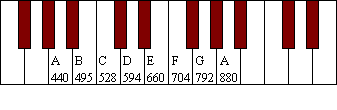
To obtain all other notes, find their octaves by halving or doubling the frequencies provided
on the keyboard above. For example, note A has the frequencies:
27.5, 55, 110, 220, 440, 880, 1760, 3520, 7040, 1480, etc Hz.
For all waves, velocity = frequency * wavelength = f.λ.
Sound waves are longitudinal waves, having oscillations in the direction of travel.
Nodes and antinodes:
In waves, a node is a point which does not move.
An antinode is the position where the amplitude is a maximum.
Harmonics
Each octave doubles the frequency of the note.
So the note C has the frequencies:
33, 66, 132, 264, 528, 1056, 2112, 4224, 8448, 16896, Hz.
The next higher C, 33782 Hz, is beyond our hearing range, but your dog may hear it.
When an instrument is sounded, it gives a lowest note, called the fundamental note,
which determines the pitch. At the same time, there are other higher notes being sounded,
called overtones, giving the instrument its unique sound.
Notes are harmonious when their frequencies are in simple whole-number ratios,
such as 4:5:6 as in C-E-G or F-A-C.
String instruments
This is a diagram for a vibrating string, such as those in a guitar or piano.
There is a node at each end. Compare this with the diagram for a tube instrument.
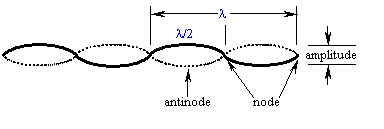
Because musical strings (guitar, piano, harp) are fixed at both ends,
there is a node at each end.
| Distance between nodes |
= |
λ/2 |
| In other words, wavelength |
= |
distance across 2 nodes. |
Tube instruments
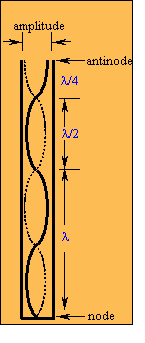
To the right is a tube showing how the wave pattern differs from that of the string, above.
The open end of the tube coincides with an antinode, which requires the addition of one λ/4.
Take a tube open at one end and closed at the other.
Vibrate a tuning fork or a guitar string across the mouth of the tube.
You will hear a faint note within the tube.
Slowly pour water into the tube till the sound is at its loudest.
(You may need a practice run at doing this.
Each time, mark the spot where you think it occurs.)
This loudest note occurs at the resonating frequency of that length of air column.
The main note in the air column has the same frequency as the tuning fork or the string vibrating
on your guitar.
If the lowest or fundamental frequency is f, then there are also higher frequencies
which are multiples of f, called harmonics.
The air temperature and the width of the mouth of the tube, affects the frequency.
Flautists literally warm up their flute before playing, by breathing into it,
as well as adjusting the closed end to alter the length of the air column.
These can help to accommodate air temperature.
Summary
For the guitar string fixed at both ends, length of string = λ/2, λ, 3λ/2, 2λ, etc.
For the open tube, length of column = λ/4, 3λ/4, 5λ/4, 7λ/4, 9λ/4, etc.
For both the string and tube, their waves:
- begin with a node
- increase their lengths by whole nodes, that is,
by multiples of λ/2 but -
the tube ends with an antinode which requires the addition of one λ/4.
In contrast to strings and tubes, the overtones from drums are not harmonics,
so drums can be said to generate noise rather than music. (Sorry, drummers.)
Naming notes
To aid our discussion we need to name each note of an octave.
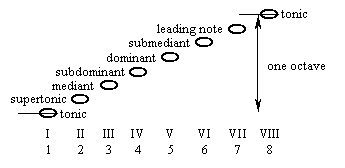
Going to the names of notes in a scale, learn:
- the 2 tonic notes, which contain the octave
- the leading note which leads to the upper tonic
- the dominant, which is the 5th note of the octave.
- the subdominant, which lies 'under' the dominant (sub = under). The subdominant is the 5th note coming down the octave.
Choosing scales
How do we choose a scale ?
- Some notes sound pleasant in sequence. Using a keyboard or guitar, try different sequences. Separate the sequences you like from those which are not so good.
- Some notes sound pleasant when sounded together (harmonics).
- Different combinations of notes generate different moods. We choose the combination which gives the mood we want.
- We could begin with any note and fashion a set of scales based on that note. However, in 1939, the base note was internationally standardized as 440 Hz, which is called Standard A.
- All the other notes are determined by how they sound along this base note 440 Hz. How any other note sounds depends upon the ratio of its frequency to the frequency 440. (See Maths chapter.)
Doubling the frequency to 880 (A'), we find that the 2 notes 440Hz and 880Hz sound well together.
We find 493, 523, 587, 659, 698, and 783, also sound well with 440 and 880 Hz. So we call this sequence of compatible notes: A, B, C, D, E, F, G, A';
and called this set of notes an octave. Originally, all this was originally done by trial-and-error without knowing anything about frequencies.
In both the chromatic and the whole tone scales, all the intervals are the same. This results in scales that have no tonal center; no note feels more or less important than the others. Because of this, most traditional and popular Western music uses major or minor scales rather than the chromatic or whole tone scales. But composers who don't want their music to have a tonal center (for example, many composers of "modern classical" music) often use these scales. In Western music, there are twelve pitches within each octave. (The thirteenth note starts the next octave.) But in a tonal piece of music only seven of these notes, the seven notes of a major or minor scale, are used often.
Making major scales
During this lesson, it is important to hear the sounds we discuss.
With a keyboard, every major scale can be played easily by using this template:
Imagine placing it over all white and black keys, and strike the key 'seen' through each hole in the template. Or just count from the first key.
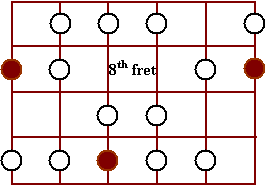
For guitarists, Joe Bennett tells use to use this single fingerboard shape if you know the names of the notes on the bass (pronounced bay-s) E string.
Use the 2-octave fretbox shape (shown here beginning at C on the 8th fret). Play it in whatever key you need by sliding the whole shape up or down the fingerboard so it begins on different notes.
The brown circles indicate root notes. The sharps and flats of the key will automatically fall under your fingers.
Using the dominant note of the previous scale
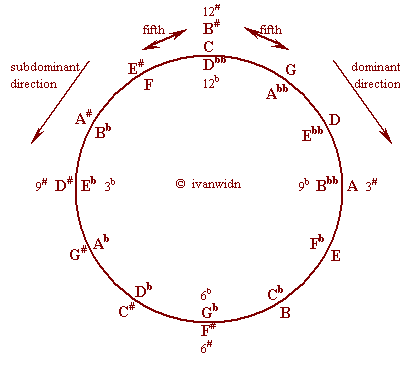
From the basic scale, C-D-E-F-G-A-B-C, called C major, we can generate other combinations which give us the moods we want. Surprize, surprize, we find there is a system in our preferences, that one scale automatically leads to another in a clear system. Let us explore.
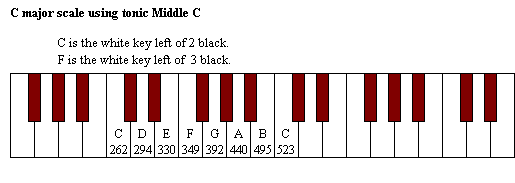
In C major, we play only the white keys of the keyboard, or what the musicians call whole notes, that is, C, D, E, F, G, A, B.
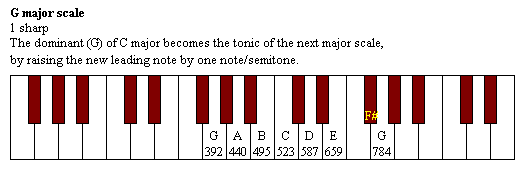
Now play the same notes but begin with G. Does it sound fine ?
Probably not. Play around, using one sharp at a time, till it sounds fine. What sharp did you select ? This set of notes then gives G major.
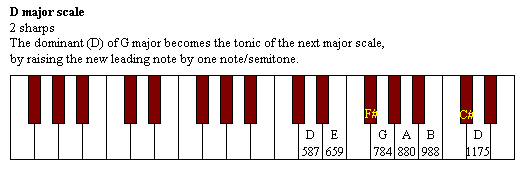
Using this set of notes, that is, for G major, begin at D. Does it sound fine ?
Which note must be raised one semitone (sharpened) ?
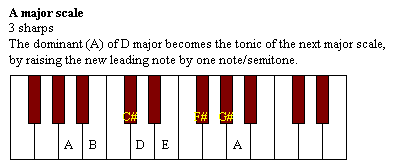
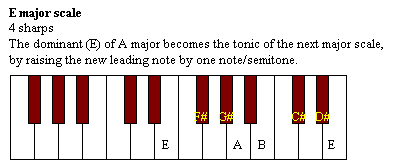
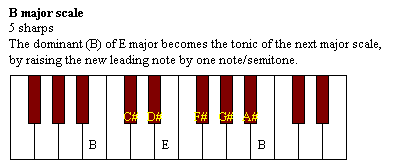
Keep going till you arrive back at C major. There are 12 such major scales. We show only 8.
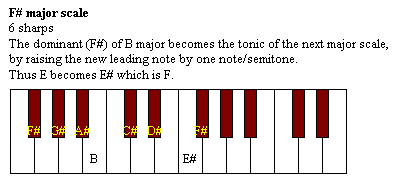
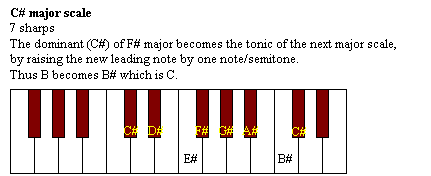
Keep going. Write out the remaining 5 major scales to find what the last one, B# major, copies.
So the first set of majors are named: C major, G major, D, A, E, B, F# majors.
These are followed by: C#, G#, D#, A#, E#, B# majors.
Note the same sequence, but simply sharpened, that is, raised by one note/semitone. Why must they be in the same sequence ?
What is another name for B# major ?
Rule: From every dominant of a major scale, a new scale can be made by sharpening the leading note of the previous scale.
Sharpen the note which is 2 semitones below the name of the scale.
To make C major - no sharps ().
From C major, use dominant G - to make G major, sharpen F (F#).
From G major, use dominant D - to make D major, sharpen C (F#, C#).
From D major, use dominant A - to make A major, sharpen G (F#, C#, G#).
From A major, use dominant E - to make E major, sharpen D (F#, C#, G#, D#).
From E major, use dominant B - to make B major, sharpen A (F#, C#, G#, A#).
From B major, use dominant F# - to make F# major, sharpen E (F#, C#, G#, E#/F).
From F# major, use dominant C# - to make C# major, sharpen B (F#, C#, G#, E#/F, B#).
and so on, till we come back to C major.
The easiest way to think of any major scale is to fill in the template with semitones:
For A# major, just put A# in the first slot, then put the 3rd semitone in the 3rd slot and so on:
Using the subdominant note of the previous scale
Instead of going the full circle in a clockwize direction generating sharps, we can go anticlockwize, generating flats and giving the major scales: F, Bb, Eb, Ab, Db ....
When going clockwize, we used the Dominant note (G) of C major to develop the next (G) major scale. Each Dominant being the 5th note in that particular scale when going clockwize, so, when going anti-clockwize, we use the 5th note going down, that is, the Sub-dominant, to build the next major.
Rule: From every subdominant of a major scale, a new scale can be made by flattening the leading note of the previous scale.
Name the scale and flatten 3 letters on.
To make C major - no flats ().
From C major, use subdominant F - to make F major, flatten B (Bb).
From F major, use subdominant Bb - to make Bb major, flatten E (Bb, Eb).
From Bb major, use subdominant Eb - to make Eb major, flatten A (Bb, Eb, Ab).
From Eb major, use subdominant Ab - to make Ab major, flatten D (Bb, Eb, Ab, Db).
From Ab major, use subdominant Db - to make Db major, flatten G (Bb, Eb, Ab, Db, Gb).
From Db major, use subdominant Gb - to make Gb major, flatten C (Bb, Eb, Ab, Db, Gb, Cb.
From Gb major, use subdominant Cb - to make Cb major, flatten F (Bb, Eb, Ab, Db, Gb, Cb, Fb).
and so on, till we come back to C major.
Again the easiest way to think of any major scale is to fill in the template with semitones, but this time putting the subdominant in the first slot. The subdominant of C major is F, so we generate F major:
where B was the leading note of C major, but now flattened to Bb to become the subdominant of F major.
From this we can see the subdominant is now Bb, so form the next major:
Note that the leading note of the previous scale has been flattened. (Eb = D#)
Repeat for the others.
These can all be brought together in the one diagram.