Minor scales
In both the chromatic and the whole tone scales, all the intervals are the same. This results in scales that have no tonal center; no note feels more or less important than the others. Because of this, most traditional and popular Western music uses major or minor scales rather than the chromatic or whole tone scales. But composers who don't want their music to have a tonal center (for example, many composers of "modern classical" music) often use these scales. In Western music, there are twelve pitches within each octave. (The thirteenth note starts the next octave.) But in a tonal piece of music only seven of these notes, the seven notes of a major or minor scale, are used often.
Naming notes
To aid our discussion we need to name each note of an octave.
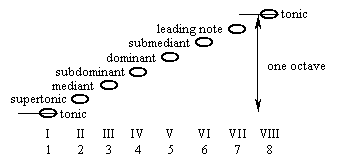
Making minor scales
Every major key has a related key which uses the same notes, but begins with a different tonic. Thus C major and A minor use the same notes, but begin on different notes. We say, A minor is the relative minor of C major.
Note that the name of the relative minor scale is 3 semitones (but 2 letters) back from the name of the major scale.
You can use this template to generate the minor scales.
Working from C major - 3 semitones back gives its relative minor, A.
Check that the C major and A minor use the same notes.
The next major is G major. The relative minor of G major is - E. And E minor is generated by:
Does this E minor have the same notes as G major ?
Generate all relative minors and compare your results with the table below.
These can all be brought together in the one diagram.
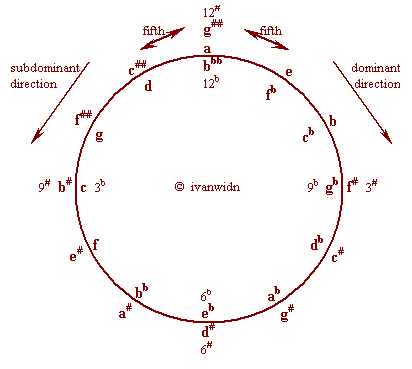
Notice that the sequence of gaps between notes is TSTTSTT where T = tone; S = semitone.
Compare the intervals for major and minor keys:
Major key: T T S T T T S
Minor key: T S T T S T T
You will also notice that the 'leading' note in a relative minor scale, is no longer leading. For the second last note to lead to the tonic, it must be only a semitone below it. This template thus clearly shows why a minor scale creates a much different mood to that of its relative major scale.
The following table gives the major and relative minor scales.
| #s or bs | Major key | Minor key |
|---|
| none | C | A |
| # | G | E |
| ## | D | B |
| ### | A | F# |
| ### # | E | C# |
| ### ## | B | G# |
| ### ### | F# | D# |
| ### ### # | C# | A# |
| bbb bb | Db | Bb |
| bbb b | Ab | F |
| bbb | Eb | C |
| bb | Bb | G |
| b | F | D |
| none | C | A |
C# major is the same as Db major.
Rules:
The submediant of a major scale is the tonic of its relative minor scale.
The mediant of a minor scale is the tonic of its relative major scale.
All the above minor scales are natural minor scales. However, their penultimate notes (second-last notes) are 2 semitones below the tonic, instead of the single semitone needed to make the penultimate note a true leading note.
So let us raise the penultimate by a semitone to get true leading notes. This gives harmonic minor scales. Again, we can use a template to get harmonic minor scales.
It stands out, doesn't it - that big 3 semitone gap ?
We can overcome this by raising semitone 2, to give:
Note that this brings us back to almost a major scale. (See template for major scales.) This scale is the melodic minor scale. All harmonic scales can be made melodic by raising the 6th note by one semitone (by 'sharpening' it). Usually, however, the music is considered to be melodically more smooth, if the 6th and 7th notes are sharpened when ascending but flattened (made natural) when descending.