Note, key or scale ?
[Internet Explorer mistakenly colors blue such numbers as 1346-1246, when they are NOT hyperlinked. Ignore the color. For these digits, refer to the tables in chapter Modes.]
This is not a new chapter, but a revision for better understanding.
I learn more quickly when I understand the language I am using; perhaps you do too.
Unfortunately musical texts give the same meaning to different terms, and different meanings to the same term.
(I suspect I have made the same mistake. Later, I will revise to correct this.)
The word note means:
- a single sound
That sound is selected from the the set of sounds defined by the musical tradition.
'Western' tradition defines a set of 13 sounds/notes (increasing in semitones) for each octave, with the standard note A being 440 Hz. Those 13 sounds can be chosen by either the Pythagorean ratios or by equal temperament, as long as all instruments in the band or orchestra, use the same set of frequencies.
Each scale selects 8 out of those 13 sounds, according to specified patterns - TTSTTTS (1356-1356), TSTTSTTS (1346-1246), and so on.
- the written symbol of a musical sound
- a key on the piano or other instrument.
The word key means:
- a key on the piano or other instrument.
- the key note of a musical piece
That is, the note (tonic) towards which the music gravitates.
- the scale of the piece
Example: the key is C major or A minor.
The word scale means:
- the key note of a musical piece
That is, the note (tonic) towards which the music gravitates: as in C or A.
- the scale
As in major scale and minor scale
- a set of notes for practising
As in C major scale: C, D, E, F, G, A, B, C
I will define these terms:
- octave
An octave is a set of 13 sounds contained by an lower and upper tonic, where the upper tonic has twice the frequency of the lower tonic. These 13 notes are selected by certain rules (Pythagorean, equal temperament, and so on).
- note
Any of the 13 semitones in an octave, and their octaves.
- key
A key is defined by:
- the key note or tonic, towards which the musical piece gravitates
- the scale, which defines the 8-note subset of the 13 notes in an octave
Thus if the key is G major, G is the tonic or key note, while major determines which subset of possible notes, is to be used.
- scale
A scale is an 8-note subset of the 13 notes in an octave. A scale is named according to the way that subset is selected (major scale, minor scale, harmonic, augmented, diminished, and so on).
Why have keys ?
Why have keys ? Why not just play the instrument ?
The key determines the key note or tonic, that is, the note to which the music gravitates. What does that mean ?
If you look at several pieces of music, noting the key, that is, the keynote, and noting the last note of the piece, what do you usually find ?
For example a piece in C major, usually ends on the note c' or its octave; a piece in G minor ends on the note g' or its octave.
Why ?
Probably because it is pre-wired into our brains. The music area of our brain is adjacent to that of language, and the two are usually related, affecting each other. Many languages are tonal; English distorts words in order to develop a regular beat; Spanish sounds musical; and so on. Language naturally produces poetry and poetry naturally produces singing. Singing leads to instruments, and both lead to music.
Singing has, for thousands of years, been a major tool to facilitate learning, such as for the songlines of Australian Yolngu ('aborigines') and epic poems.
In addition, this suggests that we did not determine scales; our brains had already decided which notes to select. (Or rather, which frequency ratios to select.)
The remaining question is why do we choose a key note of c' or a' or c'' or whatever.
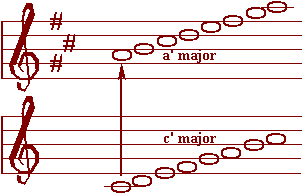
Suppose a song with its music, is in C major, with C being middle c'.
Suppose the singer has difficulty singing such low notes but is happy singing 7 notes/semitones higher. We could transpose the music, that is, rewrite it so the tonic or keynote is a' instead of c'.
This would change the key from C major to A major.
This would change the 8-note subset from:
c', d', e', f', g', a', b' c''
to:
a', b', c"#, e", f"#, g"#, a"
To adapt the banjo to the singer, place the capo on the 2nd fret and use the same fingering as used for G-tuning.
This shift would also suit the flute whose range begins at middle c'.
Remember, transposing C major to A major requires 2 actions:
- move the tonic from c' to a'
- add the sharps or flats required for the new scale, to maintain the same format for major scales: TTSTTTS or 1356-1356.