Intervals
Naming notes
To aid our discussion we need to name each note of an octave.
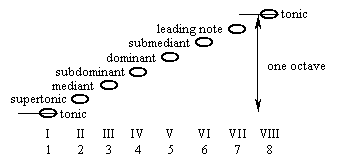
Going to the names of notes in a scale, learn:
- the 2 tonic notes, which contain the octave
- the leading note which leads to the upper tonic
- the dominant, which is the 5th note of the octave.
- the subdominant, which lies 'under' the dominant (sub = under). The subdominant is the 5th note coming down the octave.
Intervals
An interval is the gap in frequencies between 2 notes in a scale.
Unison interval is the interval between the lower tonic and itself (like a dummy interval) or between the lower and upper tonics, forming an octave.
2nd interval = gap between the first note, the tonic, and the 2nd note, the supertonic.
3rd interval = gap between the first note, the tonic, and the 3rd note, the mediant.
4th interval = gap between the first note, the tonic, and the 4th note, the subdominant.
5th interval = gap between the first note, the tonic, and the 5th note, the dominant.
6th interval = gap between the first note, the tonic, and the 6th note, the submediant.
7th interval = gap between the first note, the tonic, and the 7th note, the leading note.
octave = gap between the first note, the tonic, and 8th note, the (upper) tonic.
In particular, the 3rd interval, called simply the third, immediately distinguishes between a major scale, with TTS, or a minor scale, with TST.
And the fifth interval, or fifth, between the tonic and the dominant.
Perfect intervals are the unison, 4th, 5th and octave.
Major intervals are 2nd, 3rd, 6th, 7th intervals of a major scale.
Minor intervals are major intervals reduced by a semitone.
Examples:
In C major, the 3rd interval, C to E, is TT or (1-5) which is a major third.
In C minor, the 3rd interval, C to Eb, is TS or (1-4) which is a minor third.
You can see that a minor third is a major third reduced by a note/semitone.
Interval proportions
Calculating frequencies
There are 2 ways of calculating frequencies for an instrument:
- Pure intervals
Pure intervals use frequencies based on the harmonic series.
That occurs in the old music system before Baroque, and before music was standardized to equal temperament, which requires that each instrument sounds equally in tune whatever key it is played in.
| Interval | Proportion |
|---|
| unison | 1 : 1 |
major 2nd
minor 2nd | 7 : 8
11 : 12 |
major 3rd
minor 3rd | 4 : 5
5 : 6 |
| perfect 4th | 3 : 4 |
| perfect 5th | 2 : 3 |
| 6th | : |
| 7th | : |
| octave | 1 : 2 |
- Equal temperament intervals
Equal temperament intervals use frequencies based on the arrangement that the ratio of any 2 consecutive notes equals 1.059463... (actually the 12th root of 2).
Each octave doubles the frequency.
Thus A' (880Hz) = 2 * A (440 Hz)
How many notes in an octave:
such as A A# B C C# D D# E F F# G G#
or A' A'# B' C' C'# D' D'# E' F' F'# G' G'#
and so on.
There are 12 notes plus the octave, in an octave (called tones and semitones by musicians - but sssh - musicians think there are only 8 notes in an octave !).
Therefore each note = previous note * 12th root of 2.
This is because:
- The upper tonic or octave has twice the frequency of the lower tonic.
- There are 13 notes/semitones to the octave, that is, 12 notes excluding the upper tonic.
- These notes must be 'equally' spaced to achieve equal temperament, where 'equally' means in equal geometric proportion.
Therefore the frequency of each note/semitone must equal the previous frequency multiplied by the 12th root of 2.
Divide the frequency of the upper note of an interval by the frequency of the root of that interval.
| Interval | Ratio | Ratio |
|---|
| unison | 1 : 20/12 | 1.0000 |
| minor 2nd | 1 : 21/12 | 1.0595 |
| major 2nd | 1 : 22/12 | 1.1225 |
| minor 3rd | 1 : 23/12 | 1.1892 |
| major 3rd | 1 : 24/12 | 1.2599 |
| perfect 4th | 1 : 25/12 | 1.3348 |
| tritone | 1 : 26/12 | 1.4142 |
| perfect 5th | 1 : 27/12 | 1.4983 |
| minor 6th | 1 : 28/12 | 1.5874 |
| major 6th | 1 : 29/12 | 1.6918 |
| minor 7th | 1 : 210/12 | 1.7818 |
| major 7th | 1 : 211/12 | 1.8897 |
| octave | 1 : 212/12 | 2.0000 |
In spite of this, the pure interval proportions are fairly close to the equal temperament proportions. This is because:
- The upper tonic or octave has twice the frequency of the lower tonic.
- There are 13 notes/semitones to the octave, that is, 12 notes excluding the upper tonic.
- These notes must be 'equally' spaced to achieve equal temperament, where 'equally' means in equal geometric proportion.
Therefore the frequency of each note/semitone must equal the previous frequency multiplied by the 12th root of 2.
In spite of this, the old proportions are fairly close to the equal temperament proportions.
Augmentation
A perfect or major interval is increased by a semitone.
Diminished
A perfect or minor interval is decreased by a semitone.
Inversion of intervals
An interval and its inversion complement each other within an octave.
The 4th interval goes from the tonic up to the subdominant.
When inverting, invert the tonic up to the upper tonic, so that the intrval reaches down from the upper tonic to the previous subdominant (which, now being the 5th note, is effectively a new dominant).
An ascending 4th inverted becomes a descending 5th.
An inverted 4th interval goes from the upper tonic down to the subdominant, equivalent to an inverted 5th.
When inverting, either the lower tonic becomes the upper tonic, or the higher note goes an octave lower.