Harmonics and harmony
Overtones and harmonics
A musical note is one in which the fundamental note is accompanied by overtones whose frequencies are simple multiples of the fundamental note. Such notes are called harmonics of the fundamental note.
Example: a cello's fundamental note of low A at 110Hz, produces overtones of 220, 330, 440, 550Hz, and so on.
Noise is sound in which overtones are not simple multiples of the fundamental note.
Example: a drum's fundamental note of 50Hz, may produce overtones of 79.7, 106.8, 114.8, 145.9, and so on.
Nodes and antinodes:
In waves, a node is a point which does not move.
An antinode is the position where the amplitude is a maximum.
Harmonics
Each octave doubles the frequency of the note.
So the note C has the frequencies:
33, 66, 132, 264, 528, 1056, 2112, 4224, 8448, 16896, Hz.
The next higher C, 33782 Hz, is beyond our hearing range, but your dog may hear it.
When an instrument is sounded, it gives a lowest note, called the fundamental note,
which determines the pitch. At the same time, there are other higher notes being sounded,
called overtones, giving the instrument its unique sound.
Notes are harmonious when their frequencies are in simple whole-number ratios,
such as 4:5:6 as in C-E-G or F-A-C.
String instruments
This is a diagram for a vibrating string, such as those in a guitar or piano.
There is a node at each end. Compare this with the diagram for a tube instrument.
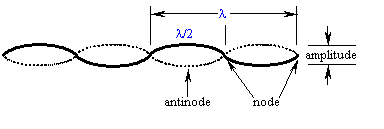
Because musical strings (guitar, piano, harp) are fixed at both ends,
there is a node at each end.
| Distance between nodes |
= |
λ/2
|
| Wavelength |
= |
distance across 2 nodes. |
Tube instruments
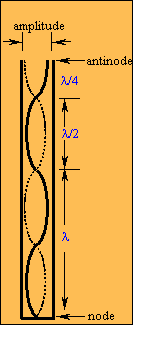
To the right is a tube showing how the wave pattern differs from that of the string, above.
The open end of the tube coincides with an antinode, which requires the addition of one λ/4.
Take a tube open at one end and closed at the other.
Vibrate a tuning fork or a guitar string across the mouth of the tube.
You will hear a faint note within the tube.
Slowly pour water into the tube till the sound is at its loudest.
(You may need a practice run at doing this.
Each time, mark the spot where you think it occurs.)
This loudest note occurs at the resonating frequency of that length of air column.
The main note in the air column has the same frequency as the tuning fork or the string vibrating
on your guitar.
If the lowest or fundamental frequency is f, then there are also higher frequencies
which are multiples of f, called harmonics.
The air temperature and the width of the mouth of the tube, affects the frequency.
Flautists literally warm up their flute before playing, by breathing into it,
as well as adjusting the closed end to alter the length of the air column.
These can help to accommodate air temperature.
Summary
For the guitar string fixed at both ends, length of string = λ/2, λ, 3λ/2, 2λ, etc.
For the open tube, length of column = λ/4, 3λ/4, 5λ/4, 7λ/4, 9λ/4, etc.
For both the string and tube, their waves:
- begin with a node
- increase their lengths by whole nodes, that is,
by multiples of λ/2 but -
the tube ends with an antinode which requires the addition of one λ/4.
In contrast to strings and tubes, the overtones from drums are not harmonics,
so drums can be said to generate noise rather than music. (Sorry, drummers.)
Harmony
Let us revise the 3 basic elements of music:
Rhythm and melody are inseparable; melody without rhythm is shapeless and meaningless (although modern meditation music is close). Harmony, although it appeared before the 800 AD, is seen as developing in the 800s with the new use of parallel 4ths and 5ths. While melody is horizontally constructed, harmony is vertically constructed by the use of overtones over the fundamental note.
Rhythm has been discussed fully. Now we turn to melody.
Melody is:
- a succession of distinguishable sounds having a limited number of pitch
- an inner tension which brings the sounds into a unit or whole.
- an alternation of tension and relaxation
such as an ascending melodic line balanced by a descending one.
There are 3 kinds of melodies:
- a step-by-step progression
- wider leaps, especially 3rds, 4ths and 5ths
- a combination of the above tow.
Harmony is:
- the simultaneous combination of 2 or more sounds
- vertically constructed by the use of overtones over the fundamental note
- natural, occurring in nature when the striking of a fundamental note causes the simultaneous production of overtones - the octave, 5th, 2nd octave, and following 3rd.
- harmonic singing began with using the overtones which occurred naturally, doubling a melody at a perfect 4th or 5th..
- Next followed singing in 4 parts by doubling both the melody and the parallel voice.
- (about the 1450s) the 3rd was combined with the 5th, to form a triad (triad = any note + 3rd + 5th above)
- the triad is the basic element of 'Western' harmony, and is the main feature up till Schoenburg's atonal music of the 1900s.
A chord is 2 or more notes sounding simultaneously.
A triad is a chord combining the fundamental note with the 3rd and 5th notes of the 8-note scale.
The fundamental note upon which a triad is built is called its root. For example, the C major root triad is built on the lower C note of C major (C, D, E, F, G, A, B C), and consists of C, E, G.
A major scale gives a major triad; a minor scale gives a minor triad in which the 3rd note is diminished or a semitone lower than that of a major triad. Fifths are always perfect.
An augmented triad has the 5th note augmented or increased by a semitone.
A diminished triad has the 5th diminished or decreased by a semitone.
In both augmented and diminished triads, the 3rd note of a major triad is unchanged, while the 3rd of a minor triad is diminished.
A triad can be built on every degree of a scale, in any key.
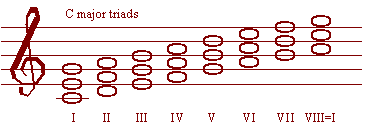
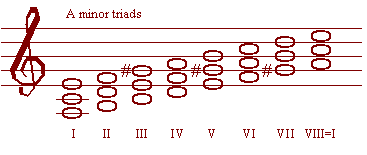
Primary triads are the I, V, and IV degrees of the scale.
Secondary triads are all the other degrees of the scale (II, III, VI, VII).
Chord progression
Major scales
Triads built on the 1st, 4th and 5th degrees are major.
Triads built on the 2nd, 3rd, and 6th degrees are minor.
A triad built on the 7th degree is diminished.
Minor scales
Triads built on the 1st and 4th degrees are minor.
Triads built on the 5th and 6th degrees are major.
Triads built on the 2nd and 7th degrees are diminished.
A triad built on the 3rd degree is augmented.
There are 2 kinds of triad-triad relationships:
- pairs of triads which share 3rd or 5th, or both 3rd and 5th notes of the scale
- neighbouring triads which do not share notes
These relationships affect chord progression.
The study of chord progression is conventionally based on 4 voices:
because:
- fewer than 4 voices do not clearly illustrate all the harmonic possibilities
- more than 4 voices is too complicated for novices to understand
- the most complex chords can be reduced to 4 parts.
For the voice ranges, see diagram in chapter Reading music.
The voice range omitted is the baritone, which overlaps the bottom range of the tenor, and the top range of the bass.
Men
Most men are baritones.
A tenor speaks in a baritone voice but raises his voice to sing tenor.
Some baritones raise their voice an octave to sing alto (but this seems to greatly reduce the timbre or overtones).
Men cannot rise above alto.
Women
Only women sing soprano.
Almost only women are naturally alto, although some men can switch from baritone to alto.
Very few women are baritones. Prolonged use of steroids will produce this quality.
Rules for arranging 4 part harmony:
- Double the root or 5th notes.
To obtain a 4th part from a triad, we double the root or 5th.
- Do not double the 3rd note.
Especially in a major triad, doubling the 3rd tends to weaken the function of the root.
- Do not double the leading note.
Because the leading note leads or resolves to the tonic, doubling produces a parallel octave motion. This should be avoided, although some classical composers did double the leading note.
- Write the bass and tenor on the bass staff, and the alto and soprano on the treble staff. The tails of notes for the bass and alto point down; tails of notes for tenor and soprano point up. This enables separation of parts when reading the music.
- Avoid spaces larger than an octave between tenor and alto, between alto and soprano.
- Allow spaces larger than an octave between bass and tenor.
- Avoid haphazard succession of chords.
Haphazard succession of chords prevents a satisfying harmonic progression. Music chords are linked according to 'rules' based on acoustic and aesthetic experience and intuition.
Choose out of these possible chord progressions:
| Chord played | Choice of progression |
|---|
| I | tonic | any chord |
| II | supertonic | V, III, IV, VI, VII |
| III | mediant | VI, IV, II, V |
| IV | subdominant | V, I, VI, II, VII, III |
| V | dominant | I, VI, III, IV |
| VI | submediant | II, V, IV, III |
| VII | 7th | I, VI, III, V |
- Choose direction for voices progressing between chords
The voices can move in one of 3 ways:
- Similar motion
Two or three parts move in the same direction.
- Contrary motion
Two parts move in different directions.
- Oblique motion
One part moves but the other does not.
- To avoid monotony in part writing rarely use:
- consecutive or parallel octaves and 5ths.
From about 1400 to 1900, these were avoided.
- 'hidden' octaves and 5ths.
'Hidden' octaves or 5ths appear when 2 parts jump in similar motion to reach an octave or 5th. In contrast, moving the upper part by step, made the octave or 5th progression acceptable.
These are not absolute, but use only for specific purpose.
- Try chord inversion
Chord inversion occurs when the lowest note in the chord is not the root. This can give more harmonic and melodic variation, and smoother chordal progression. The descriptions are:
- root position
with root as lowest note, chord named without suffix: I, II, III, IV, V, VI, VII, I.
- 1st inversion
with 3rd as lowest note, chord named with letter 'b' as suffix: Ib, IIb, IIIb, IVb, Vb, VIb, VIIb, Ib.
- 2nd inversion
with 5th as lowest note, chord named with letter 'c' as suffix: Ic, IIc, IIIc, IVc, Vc, VIc, VIIc, Ic.
Cadences
Revision
Primary triads are the I, V, and IV degrees of the scale.
Secondary triads are all the other degrees of the scale (II, III, VI, VII).
In speech, cadence is the falling pitch of voice denoting the end of a sentence.
In music, cadence is the falling pitch denoting the end of a piece. This can be done using primary chords, as in the sequence: I IV V I.
There are 4 cadences based on the progression of primary chords:
- Perfect
- Plagal
- Interrupted
- Imperfect.
In more detail, these 4 cadences are:
- Perfect
The perfect cadence or full-close (as in 'full stop') goes from V to I (dominant to tonic).
- Plagal
The plagal or Amen cadence goes from IV to I (subdominant to tonic).
- Interrupted
The interrupted cadence goes from V to VI (dominant to submediant) instead of to I, giving an inconclusive feeling, like a comma or dash. Appears inside a piece; never at the end. This interrupted cadence, sounds interrupted.
- Imperfect
The imperfect cadence or half-close, goes from any chord, especially II, IV, VI or I, to V. Suggests a comma or semi-colon.
A masculine cadence is one ending on a strong beat.
A feminine cadence is one ending on a weak beat.
Picardy 3rd
When a major chord is used to end a minor key piece. Its effect is a switch in mood, from sadness to optimism.
Cadential 6/4
This is the 2nd inversion of the tonic chord, to make its function dominant, meaning that aural satisfaction occurs only when the dominant chord is reached. It is considered to be dissonant when above the bass. The 4th with the 6th over the root sounds like a double appoggiatura, which according to classical rules, has to resolve to the dominant chord.
Consonance and dissonance
Definitions
Consonance = aurally satisfying. This is said to occur when the 2 notes of an interval share one or more overtones. The more overtones shared, the more consonant the interval is.
Dissonance = aurally dissatisfying, thus causing tension.
Intervals
Consonant intervals are: octave, perfect 5th, perfect 4th, 3rd and 6th.
Dissonant intervals are: 2nd, 7th, 9th, and so on.
Chords
A chord is consonant when it contains only consonant intervals.
A chord is dissonant when it contains only dissonant intervals.
Dissonant intervals and chords bring the excitement of tension, which is finally resolved by consonant intervals and chords. Without dissonance, music becomes colorless and boring.
Dominant and secondary sevenths
A dissonant note may be added as the 4th note of a chord, often the 7th above the root. For example, the little number '7' would superscript the roman number indicating degree, to show the 7th chord. The 7th would then resolve by falling a step, to I or VI. If inverted this 7th is denoted by V7d, and called a 3rd inversion.
Secondary 7ths are chords other than the dominant, having a 7th. All can be inverted.
Decorative or unessential notes
Harmony notes are essential; non-harmony notes are unessential. Unessential notes are essential to forming a melody by creating dissonance.
The most common unessential notes are:
- On the weak beat or fraction of the bar
- Passing note
A passing note lies between 2 harmony notes, a 3rd or a 2nd apart, to join them melodically. Passing notes usually occur on the weak beat of the bar; can move alone, in parallel 3rds or 6ths, and chromatically (in semitones).
- Auxiliary note
There are upper and lower auxiliary notes, lying decoratively betwen unchanged harmony notes; can move usually occur on the weak beat of the bar; can move in parallel 3rds or 6ths, and chromatically (in semitones).
- Anticipation note
Commonly used in cadence; is sounded just before and for shorter length than expected.
- Suspension note
The opposite to an anticipation note; arrives later than expected; causes more dissonance than the above; expresses emotion. there is a tie which delays the note while the chord changes.
- On the strong beat
- Appoggiatura
Appoggiare to lean upon, rest. A grace-note, just above or below a primary note, which it precedes and delays. Resolves by moving a tone or semitone to the weak beat.
'Exotic' chords
Chords with special quality useful for harmony are:
- 9th, 11th, 13th chords (called jazz chords)
The dominant 7th receives an extra note on the 9th, 11th, or 13th respectively, above the root. In 4-part harmony, this requires dropping the 5th note.
The dominant 9th chord is root, 3rd, 7th, 9th notes.
The dominant 11th is root, 3rd, 7th, 11th notes.
The dominant 13th is root, 3rd, 7th, 13th notes.
Usually the chord is on the dominant but may be on I, II or IV.
The 9th, 11 and 13th notes are dissonant notes and usually resolved by moving down.
- diminished 7th chord
If the interval between the root and the 7th note, is a diminished 7th interval (in C major, from B to Ab).
The diminished triad can be built on the 7th note of any scale. In C major the diminished triad is B D F. If Ab, the minor 3rd above F, is added, this becomes the diminished 7th chord, a chain of minor 3rds. Similar to a dominant chord, the diminished 7th chord is resolved by moving to the dominant or to the tonic chord.
- Neapolitan 6th chord
The Neapolitan 6th chord is the 1st inversion of the supertonic triad, bu twith the root and 5th lowered a semitone to give a melancholy languishing mood. (In minor keys only the the root is lowered.) In minor keys only the root is lowered. Although not a discord, its usual progression is to the the dominant or to the cadential 6/4 because of its subdominant character.
- Augmented 6th chords:
- German 6th chord
bass + major 3rd + flattened 5th + augmented 6th
- Italian 6th chord
bass + major 3rd + augmented 6th (the 3rd is doubled and the 5th omitted.)
- French 6th chord
a bass + majot 3rd + augmented 4th + augmented 6th
All these chords can occur on the flattened submediant of any minor scale. They all have an augmented 6th. Usually in the root poistion, they progress to the cadential 6/4 or directly to the dominant chord.
Modulation
Revision
In order to avoid monotony, we use:
- various chords
- chord inversion
- 'unessential' notes
- dissonance
- modulation (key change).
Definitions
Modulation is the change from one tonal center to another (change of key).
Transposition is the re-writing of a melody and/or chords into another key.
Think key change - think circles of 5ths.
See chapters: Major scales and Minor scales.
There are 3 main methods of modulation:
- Diatonic modulation
- Chromatic modulation
- Enharmonic modulation
Diatonic modulation
Diatonic modulation is the modulation in which a chord, common to both the initial key and the new key, is used to move from first key to the new (and later, back again).
Example 1:
C major and G major share the chord C E G.
The chord C E G is C major's tonic chord.
The chord C E G is G major's subdominant chord.
To change key from C major to G major:
- move to the C major tonic chord (= subdominant of G major)
- move to the dominant chord of G major
- move to the tonic of G major
- you are now in G major.
Using the symbol '>>' to indicate 'move to', we have:
Key of C major >> C tonic chord
C tonic chord = G major subdominant
G major subdominant >> G dominant
G dominant >> G tonic chord
G tonic chord = key of G major.
Example 2:
C major and F major share the chord C E G.
The chord C E G is C major's tonic chord.
The chord C E G is F major's dominant chord.
To change key from C major to G major:
- move to the C major tonic chord (= dominant of F major)
- move to the tonic of F major
- you are now in F major.
Using the symbol '>>' to indicate 'move to', we have:
Key of C major >> C tonic chord
C tonic chord = F major dominant
F major dominant >> F tonic chord
F tonic chord = key of F major.
Chromatic modulation
Chromatic modulation makes a sudden step from one key to another key, without using a shared chord.
This requires a leap from a chord in one key to an entirely unrelated chord belonging to another key. However, at least one note must be common to both keys.
Enharmonic modulation
Enharmonic modulation changes key byusing one or more notes of a chord to enharmonically change to another chord of the desired key.
'Exotic' chords are often used, especially:
- diminished 7th chord
- Neapolitian 6th chord
- German 6th chord
Try modulating from C major to Gb major by using the diminished 7th chord and then try using the Neapolitan 6th chord.
Try modulating C major to Db major and back, using the German 6th chord. This German 6th chord is especially useful when there is only a semitone difference between keys, that is, between the names of the keys, as in C major to Db major or B major.
Sequence
A sequence is the repetition at different pitches, of a short fragment. This can be done:
- without modulation by moving an octave within the same key
- with modulation by changing through several keys, say, C major to G major to D major.
A sequence should be limited to 3 or 4 changes to avoid monotony.
For Counterpoint, Canon, Fugue
see chapter Melody.