Maths

Quick revision

In 'western' music, out of an infinite number of different possible notes, 88 notes are selected over a range from 27.5 Hz to 4186 Hz, inclusive.
These notes are selected because:
A staff is made of 5 ledger lines.
Each line and each space takes a letter of the alphabet as a name: A B C D E F G, which are then repeated to go higher or lower in pitch.
This gives only 7 different notes, when 12 are needed for 'western' music, so the symbols # and b are added to 5 levels of notes to indicate another 5 notes. Thus A# has nothing to do with the A note at all. A# is the note which is above the note A, and below note B; geometrically halfway between; selected from the array of acceptable notes for 'western' music.
Frequency of A# = (frequency of A) * 1.059....

An octave is a range of notes such that the top note has twice the frequency of the lowest note.
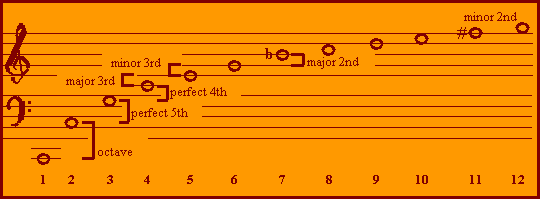
An octave for a particular key in a diatonic scale, is (usually) a selection of 8 notes out of a possible 13 regularly spaced notes. Remember that the 13th note has double the frequency of the 1st note. An octave occupies 41/2 ledger lines.

European music is usually, but not always, set on horizontal evenly-spaced lines called ledger lines.
These ledger lines are usually grouped into two sets of 5. The upper set is called the treble staff; while the lower is the base staff. Tenor and alto staffs are also used. Additional notes which do not fall on these staffs are set on short ledger lines.

The ledger lines on the treble staff run upwards as e' g' b' d' f'.
The ledger lines on the bass staff run upwards as g b d f a.
The ledger line through the middle of the treble clef (G clef) is middle g'. [g' = second line up.]
The ledger line through the semicolon of the bass clef (F clef) is f. [f = second line down.]
The ledger line between the treble staff and the bass staff is middle c'.

Middle c' is NOT the middle of anything, neither of the piano, nor of the singing range. Nor does it lie in the middle of the gap between bass and treble staffs, being the 3rd note above the bass staff and the 4th note below the treble staff.

You can see that the writing of music is an illogical mess, but because it is easier for everyone to learn it than for one person to change it, the writing of music will always be a mess.
Unless ... you invent a radically new system.

Calculating frequencies

There are 2 ways of calculating frequencies for an instrument:
In spite of this, the pure interval proportions are fairly close to the equal temperament proportions, although the difference is discernable to a musical ear.

Beginning with A = 27.5Hz, we can calculate all the equal-temperament frequencies like this:
A#    =      A * 21/12
     =      27.5 * 1.05946309436...
     =      29.13524...
     =      29

B    =      A * 22/12
     =      27.5 * (1.1225...)
     =      30.86875...
     =      31

Keep going till we reach octave A, which is simply octave A = 2 * A = 2 * 27.5 = 55Hz.
Then we do the next octave using A = 55Hz as our starting figure.

These calculations give the equal-temperament frequency table:
 
OctaveAA#BCC#DD#EFF#GG#
127.52931333537384144464952
25558626569737882879298104
3110117123131139147156165175185196208
4220233247262277294311330349370392415
5440466494523554587622659698740784831
6880932988104711091175124513191397148015681661
7176018651976209322172349248926372794296031363322
83520372939514186For decimal figures see References/note frequencies.

Take any frequency and double it to get the frequency of the same note in the octave above (below it in the table).
Take any frequency and multiply by 1.059463 to get the frequency to the right of it. Small discrepancies occur because of rounding.

Middle C is C4 with frequency 261.626.
Concert A is A4 with frequency 440.000, as tuned to the principal oboe or first violinist.

One musician gives top c''''' as 4096 Hz instead of 4186Hz.
Firstly, multiply 27.5Hz for A' by 27 to give 3520Hz for A'''''.
Then multiply this 3520Hz by 1.1892 to give 4186Hz for c'''''.
I suspect that the musician's discrepancy arises from taking 32Hz for c' and multiplying by 27.
This does not take into account that 32 Hz for C' is only an approximation. This slight inaccuracy, when multiplied by 27, becomes significant.

Frequencies for scales

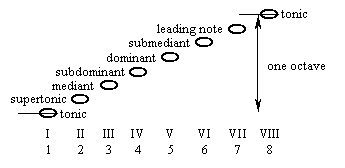
To aid our discussion we need to name each note of an octave. octave01.gif not found
Going to the names of notes above, learn:
There are 2 ways to generate all major and minor scales:
We find all our major scales by this process:
The next table shows all the major scales, in sequence.
Try to pick patterns. Draw diagrams to memorize them.
 
CC#DD#EFF#GG#AA#BCC#DD#EFF#GG#AA#BC
262 294 330349 392 440 494523
G major392 440 494523 587 659 740784
D major294 330 370392 440 494 554587
A major440 494 554587 659 740 831880
E major330 370 415440 494 554 622659
B major494 554 622659 740 831 932988
F# major370 415 466494 554 622 698740
C#277 311 349370 415 466 523554
G# major415 466 523554 622 698 784831
D# major311 349 392415 466 523 587622
A# major466 523 587622 698 784 880932
E# major349 392 440466 523 587 659698
262 294 330349 392 440 494523

There are so many patterns in this table, both horizontal and vertical:
All this can be repeated using the subdominants instead of dominants. This generates scales with flats instead of sharps.

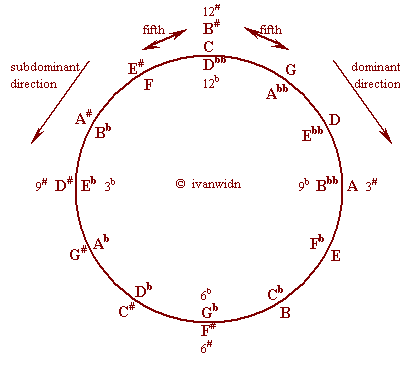
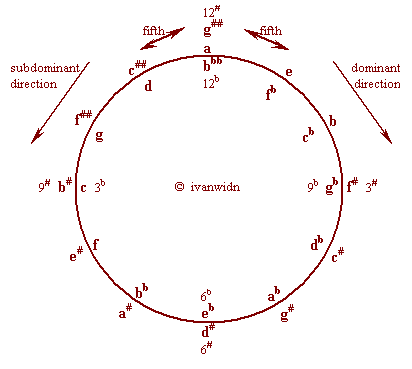
This information is summarized in the so-called 'circle of 5ths' (circle of 8ths ?) below, with the dominants generating the clockwize circle and the subdominants generating the anticlockwize circle, in each diagram..

For the complete set of majors in 'western' diatonic scales:

circle_of_major_scales.gif not found

For the complete set of natural minors in 'western' diatonic scales:

circle_of_minor_scales.gif not found