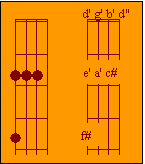
5-string banjo

Warren Yates' www.projectsandhobbies.com gives a good banjo-starter, with examples to listen to.

Scales

banjo_d_major.gif not found A good scale to begin when the banjo is tuned to open G, is D major.
D major runs from d' to d" but with f'# & c"# instead of f' & c".

The advantages of using D major to learn note positions are: This easy fingering allows us develop a 'feel' for the notes without strain.

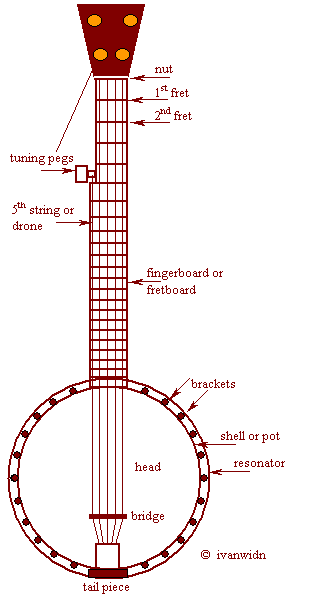
What is a banjo ?


banjo.gif not foundIf it sounds like a banjo, it is a banjo.

The modern banjo sound, like the sound of a Harley-Davidson, is unique and this is due to its unique structure. No other instrument sounds anywhere similar. You cannot be mistaken. Sorry, but I have yet to find a better definition.

This banjo sound is created by:
  • the head, a skin over a shell or pot
  • the bridge on the flexible head
  • a percussive sound
    by using fingernails or plectrum or finger picks
    Although use of nails, plectrum or finger picks, is not unique, it gives a percussive sound in addition to the plucking sound of fingers.
  • the drone.
    This is given by the shorter string.
    This is the chief characteristic.
    The 4-stringer without the drone, and the 6-stringer, are not true banjos.

Banjos come in different types:
  • the usual 22-fret
  • the long-necked banjo of 25 frets, invented by Pete Seeger
  • 4-string tenor banjo, tuned to the fiddle
  • fretless banjo with its softer sound
  • 4-string, including a drone string
  • African banjars, the original banjos which used gourds for drums
  • and so on.

Tuning

Strings are numbered from the right, so that the short string on the left is the 5th string.
The fingers of both hands are numbered from the index finger (as number 1).
The symbol 4(1) indicates the 4th string is fretted at the 1st fret.
3(4) indicates the 3rd string is fretted at the 4th fret.
1(0) indicates the first string is not fretted.

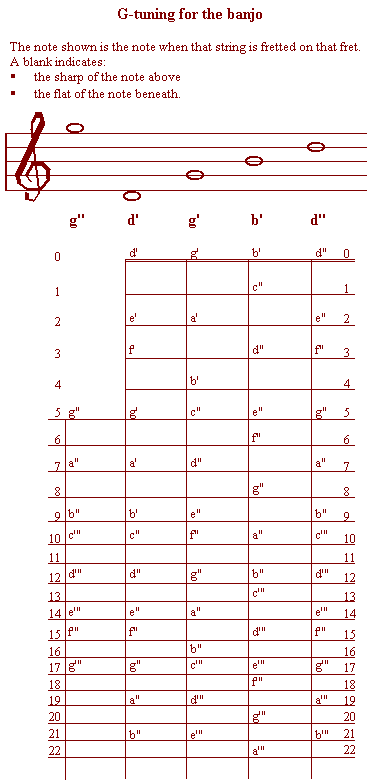
The 5-string banjo is usually initially tuned to open G, that is, without fretting the strings, strumming plays the G-chord. The nut at the head of the fingerboard/fretboard, frets the strings for us.

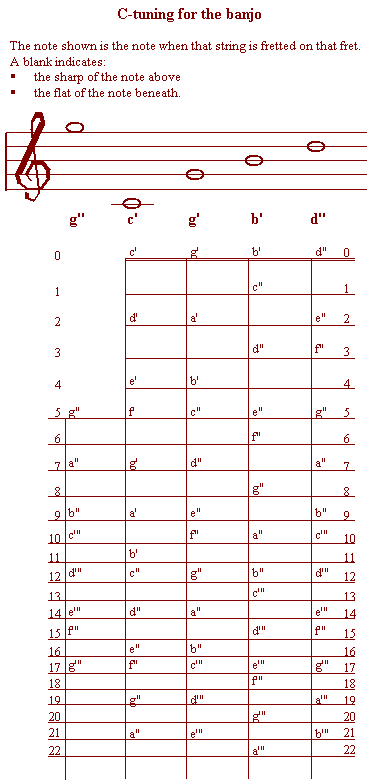
The next most-used key is C-tuning, which merely changes the 4th string from middle D (d') to middle C (c') - refer to Introduction/Reading music.

Here are the notes for the open strings. The note g" is an octave above g' in the middle ocatve in a piano, and d" an octave above d'.

KeyString
54321
G tuningg''d'g'b'd''
C tuningg''c'g'b'd''
D tuninga''d'f#a'd''

Each of these tunings has variants - see Pete Seeger's How to play the 5-string banjo p66.


Using this diagram with the g'-string providing the standard note, observe: This will be used for tuning.

[From Fred Pribac, Hobart musician, teacher, instrument maker]
The banjo's bridge must be placed correctly. The distance from the nut to the 12th fret = distance from 12th fret to bridge. However other factors influence this. If the fretted note is flatter than the harmonic, move the bridge further down.
The bridge is usually angled to compensate for the different qualities of string. A 'hard' string, like the 2nd & 3rd strings, oscillates towards the lower edge of the nut. A yielding string, such as the thin 1st string or the coiled 4th string, will oscillate towards the top edge of the nut. This changes the effective length of the string. Angling the bridge or using a bridge 'bent' in the middle, helps to compensate.
This angling would be no more more than the thickness of the nut.
However, if you have just bought your banjo, it may need to be setup correctly by adjusting the bridge [FB]. If you need to read this section on how to tune a banjo, you may need to take your banjo to a banjo expert (not a guitar expert).

When 2 strings are close to the same note, you will hear the beat as they interfere with each other. This beat is heard as an oscillation in amplitude or loudness. When their notes exactly match, they will only reinforce each other, and the beat disappears.

For open-G tuning:
Ease off the strings slightly so their notes are flat. Tune only by increasing tension.
Then tune in this sequence.

StringOpen noteWhich fretg' string fret
3rd string
5th string or drone
4th string
1st string
2nd string
g'
g"
d'
d"
b'
open
12th
5th
open
open
use tuner
open
open
4th **
7th
** Or tune the open string to the 12th fret of d' string.

All strings: do this tuning 3 times. Tuning any string changes the dynamics of the banjo, and thus affects the tuning of the other strings.

The g' string is the standard against which other strings are tuned. Comparing other strings against this one standard string, reduces compounding errors. Also tuning by comparison of higher notes is more accurate than by comparison of lower notes [FB].
The banjo is never perfectly in tune for all strings, nor for all notes on the one string.
The 12th fret raises each string an octave.
When tuning, always approach the note from a slack wire. Ease the tension of the string. This can be interpreted as approaching the note from below, that is, from the flat note. The reason is that the friction of the bridge resists movement of the string. When tightening the string, the keys pull on the wire and overcome that friction. When loosening the wire there is no force at the tail piece to pull the string back across the bridge. This can result in tuning the string, only to have the bridge 'release' it, later on.

The air inside the drum resonates. Open-backed banjos 'use' the player's body as a back. Wooden-backed or hard-back banjos resonate more to the high frequency end; soft-backed resonate more to the lower frequency end. Thus the backing changes the sound of the banjo as well as the loudness.
The sound is also changed by the type of strings, the use of frets, the type and quality of wood and metal, the use of mufflers inside the drum, and so on.

banjo_c_tuning.gif not found

Retune from G to C tuning

How do we retune from G to C tuning ?
We need to retune only string 4, from d' to c', that is, by dropping 2 notes/semitones.
Match the 7th fret of c' string to the open 3rd or g'-string which is our standard note.

But what if every string is out of tune ?
Tune as for G-tuning, but set the 4th string 7th fret equal to open g'-string.

Strumming and rolling

The nail-brush strum:
The nail-brush strum has 3 parts in this sequence:
The Earl Scruggs roll:
Before bothering with chords, I learnt the Earl Sruggs roll first, so I could practice the roll without thinking while later testing the sound of the fretted strings.
Thumb picks strings 3, 4, 5 with a downward motion.
Index finger picks string 2 with an upward motion.
Middle finger picks string 1 with an upward motion.
Form your hand into a claw with your index on string 2.
Pluck 3, 2, in sequence. Practice till comfortable.
Pluck 5, 1, in sequence. Practice till comfortable.
Combine these sequences. Pluck 3251 in sequence. Practice till comfortable.
Pluck 4251 in sequence. Practice till comfortable.
Combine these sequences. Pluck 32514251 in sequence. Practice till comfortable.
Now you have the Earl Scruggs roll.
If you practise for 5-minutes 10-times a day, you will have it in about 3 days.

Warren Yates advocates these rolls:

Learning chords

Whenever you play a chord, you can use the Earl Scruggs roll to hear if the strings resonate clearly. If not, adjust your fingertips till they do. The main problems are:
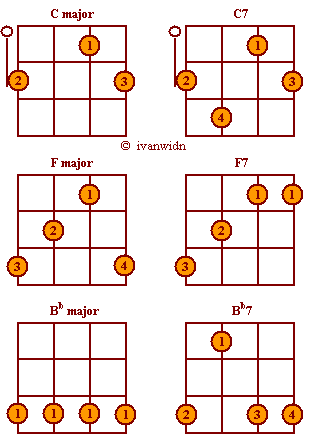
Learn open-G, C and D7, because these cover most folk songs.

Chris says:
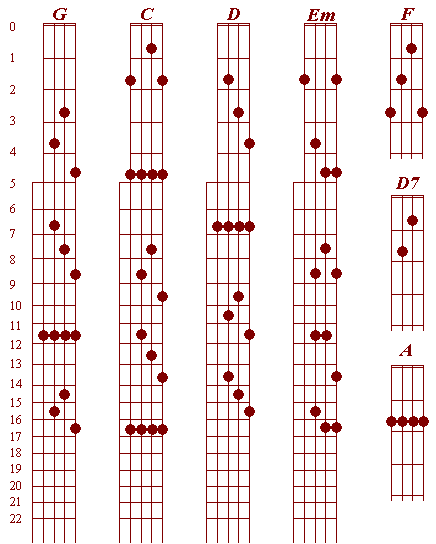
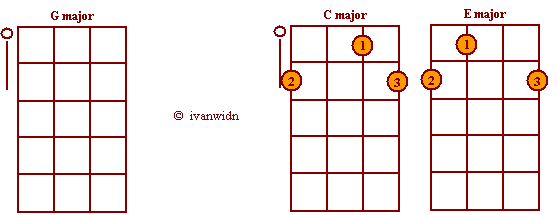
Try this image of chords for G and C tuning. Size = 95KB.
To enlarge, hold down [Ctrl] and click [+/=] repeatedly.
To return to this page, click the 'Back' button on your web browser.

Playing chords

The 5-string banjo is usually initially tuned to open G, that is, without fretting the strings, strumming plays the G-chord. The nut at the head of the fingerboard/fretboard, frets the strings for us. Strings are numbered from the right, so that the short string on the left is the 5th string.
The fingers of both hands are numbered from the index finger (as number 1).
The symbol 4(1) indicates the 4th string fretted at the 1st fret.
3(4) indicates the 3rd string fretted at the 4th fret; 1(0) the first string not fretted at all.

You can get by on only these chords. The first G is open, that is, without fretting with the left hand. Fret only the notes you need.

The 5th string is always played open, being used only to fill in a gap in a run so it flows more easily.


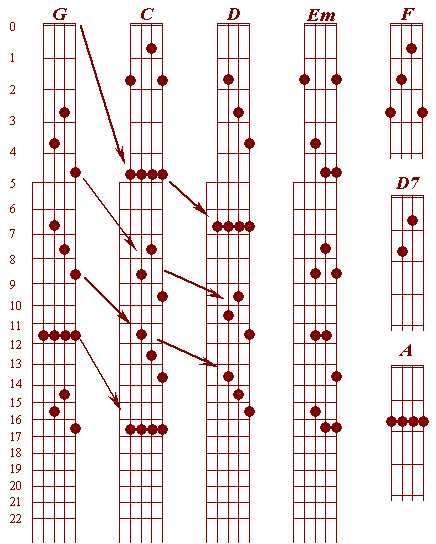
The next diagram is the same but it emphasizes three finger positions used to generate chords. Imagine that the first G-chord is all strings fretted on the zero-th fret. This is then repeated for the C-chord on the 5th fret and for D-chord on the 7th fret.

Using the same all-four-strings fretted on the same fret, but move all down 12 frets (G, C, D move from 0, 5, 7 to 0+12, 5+12, 7+12).

In between, there are 2 other variations for each chord. Study their similarity.
On the first string (the string on the right), move down 5 frets, then 4 frets, then 3 frets, then 5 frets again.
1st string is 5, 4, 3.
2nd string is 3, 5, 4.
3rd string is 4, 3, 5.
4th string is skip, skip, 12.
Note the cyclic nature: 5 - 4 - 3 - 5 - 4 - 3 - ... where 5 + 4 + 3 = 12.)

banjo_chords_2.gif not found

The 5th string is tuned to match the 1st string when fretted on the same fret (with an octave difference).
Warren Yates advises tuning the first 4 strings for the banjo like a guitar but lower the first string until the 4 strings make a good plane chord.

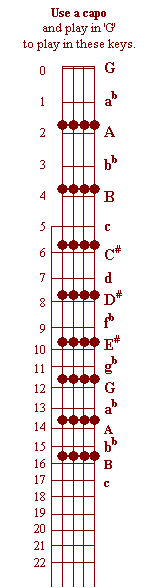
To play the A-chord, you can put a capo on the 2nd fret, and play in the G-position. Without a capo, use a pencil and rubber band.

The capo

The banjo capo is a device for clamping strings 1 - 4 on a particular fret, in order to change the key. This also enables you to play the chord fingering you know without learning the chord fingering in the 'new' key.

The usual key for the banjo is open-G. This is open because when you strum without freting any strings, you strum the G-major chord. But the 4 strings are automatically fretted at the 0th fret by the nut (the 'fret' between the fingerboard and the head).
Strum by brushing down strings 1 - 4 with the nails of fingers 2, 3, 4in a quick firm move.

If you now place a capo on the 2nd fret, you change the key from G to A, and you can use the G-fingering to play in A.

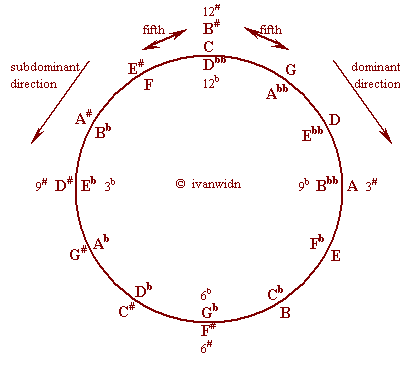
As you move a capo along to each even-numbered fret, you move around the 'circle of fifths' for major scales.

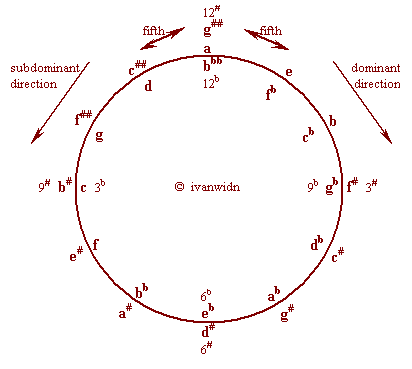
As you move a capo along to each odd-numbered fret, you move around the 'circle of fifths' for minor scales.

The 5th string has its own capo for which there are 2 types:

banjo_capo.gif not found Major scales
circle_of_major_scales.gif not found
Minor scales
circle_of_minor_scales.gif not found


This chart gives the key for both G and C tunings, by the fret holding the capo. Finger as though the capo is the beginning of the banjo neck, that is, the nut.

Capo on fret number ...G tuningC tuning
1G#C#
2AD
3A#D#
4BE
5CF
6C#F#

If you have a long-necked or Seeger banjo, the tuning open is A in C tuning or E in G tuning. At the 1st fret this will become A# or F, at the 2nd B or F#. At the 3rd fret, C or G, as with the normal 5-string banjo. And continue from there.

To transpose music, use the transposition chart.

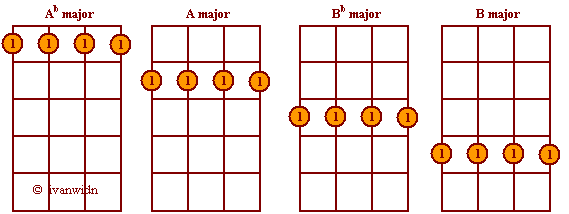
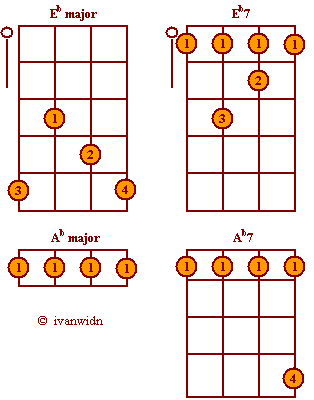
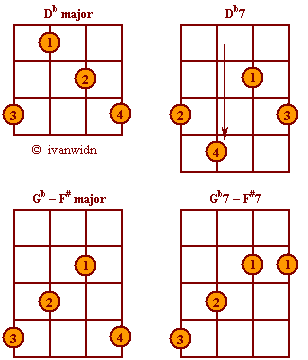
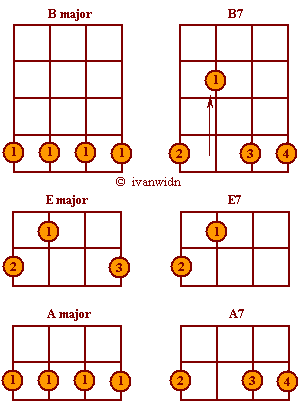
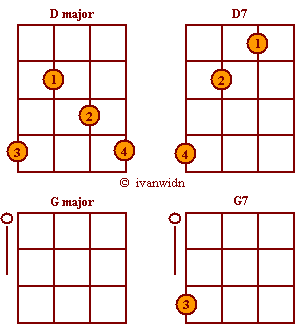
Major chords for G-tuning

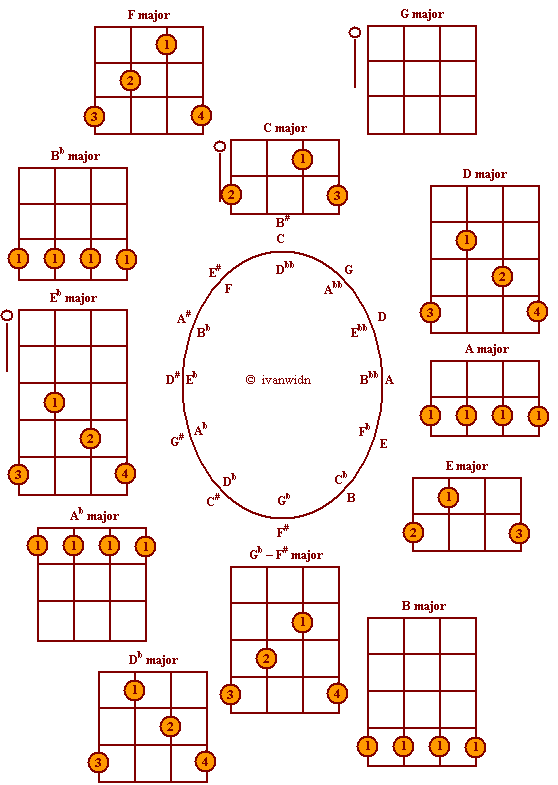
Here are the major chords for G-tuning, arranged in the circle of major scales.

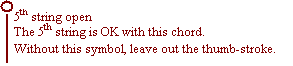
open_5th_string.gif not found
banjo_major_chords_circled.gif not found

Fingering patterns for major chords

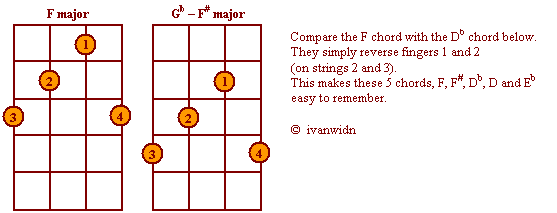
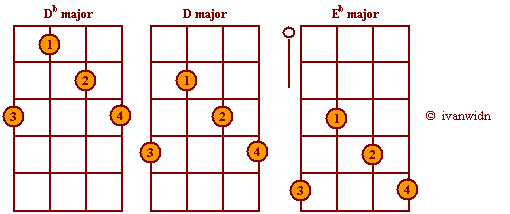
The next diagram shows the same major chords for G-tuning, arranged horizontally in sets having similar fingering. In some sets, go sideways to see the same fingering sliding down one fret. In others there is a simple change of one finger position.

banjo_major_chords_1.gif not found banjo_major_chords_2.gif not found banjo_major_chords_3.gif not found banjo_major_chords_4.gif not found

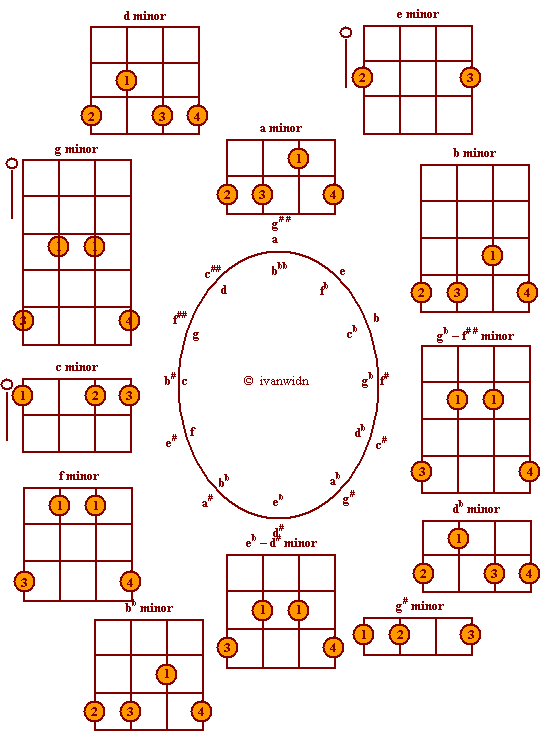
Natural-minor chords for G-tuning

Here are the natural minor chords for G-tuning, arranged in the circle of minor scales.

open_5th_string.gif not found
banjo_minor_chords_circled.gif not found

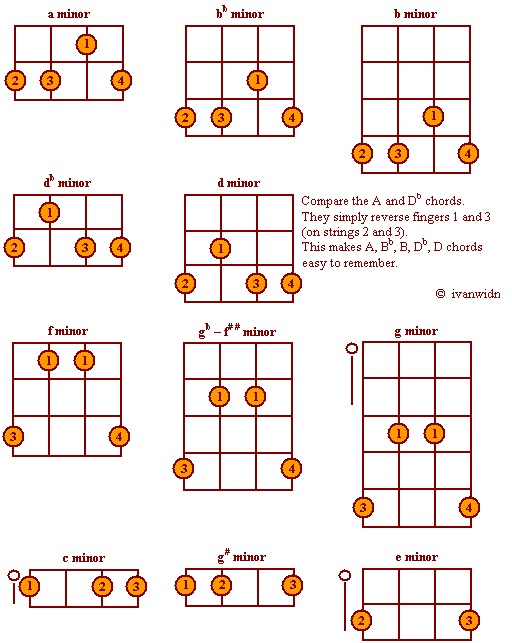
Fingering patterns for minor chords

The next diagram shows the same minor chords for G-tuning, arranged horizontally in sets having similar fingering. In some sets, go sideways to see the same fingering sliding down one fret. In others there is a simple change of one finger position.
banjo_minor_chord_patterns.gif not found

Fingering patterns for 7th chords

These 7th chord fingerings are compared with the major chord from which they are derived. I think this comparison facilitates learning them.

banjo_7th_1.gif not found banjo_7th_2.gif not found banjo_7th_3.gif not found banjo_7th_4.gif not found banjo_7th_5.gif not found

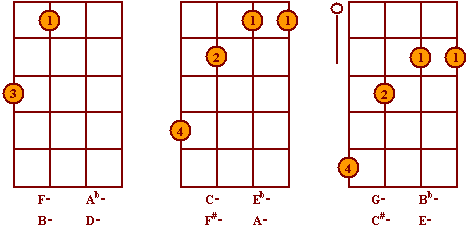
Diminished chords

Note that the first example moves down by one fret each time to form the other two examples.
The (-) indicates a diminished chord.

banjo_diminished_chords.gif not found

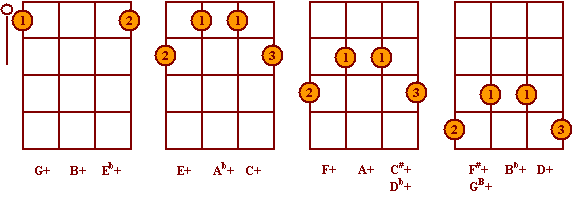
Augmented chords

Note that the first example moves down by one fret each time to form the other three examples. The (+) indicates an augmented chord.

banjo_augmented_chords.gif not found

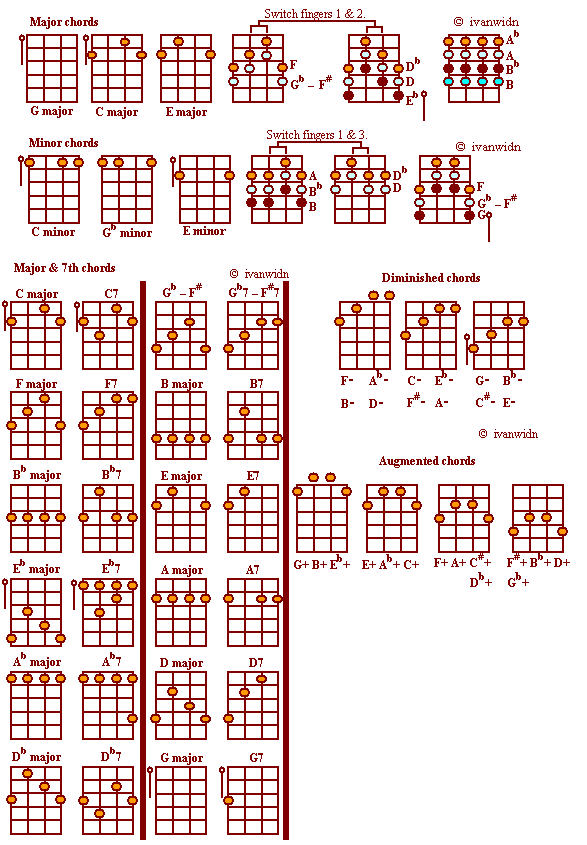
The all-chords sheet

Who am I kidding ?
There are 280 banjo chords, of which the beginner need learn only open-G, C, D7 to play most folk music.
Nonetheless, in G-tuning, the major, major 7th, minor, diminished and augmented chords, number only 41 altogether, and show regular patterns which are easily memorized.
I said memorized; playing takes years of practice.

Now that you have learnt those 41 chords, you will need a reminder sheet.
Tuning is: g D G B d, also written as g" d' g' b' d".

banjo_all_chords.png not found