Contents
Definition
Use
Name of the instrument
How to play
Types of recorders
Renaissance to Baroque to modern
Standard pitch
Sheet music notation
Fingering Dynamics
Recorder ensembles
|
Contents
Definition
Use Name of the instrument How to play Types of recorders Renaissance to Baroque to modern Standard pitch Sheet music notation Fingering Dynamics Recorder ensembles |
|
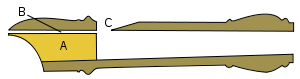 Cross-section of the head of a recorder
The recorder is held outwards from the player's lips (rather than to the side, like the "transverse" flute). The player's breath is compressed into a linear airstream by a channel cut into the wooden "block" or fipple (A), in the mouthpiece of the instrument, so as to travel along this channeled duct (B) called the "windway". Exiting from the windway, the breath is directed against a hard edge (C), called the "labium" or "ramp", which causes the column of air within the resonator tube to oscillate at the desired frequency, determined by the bore length or open tone hole used. The length of the air column (and the pitch of the note produced) is modified by finger holes in the front and thumb hole at the back of the instrument.
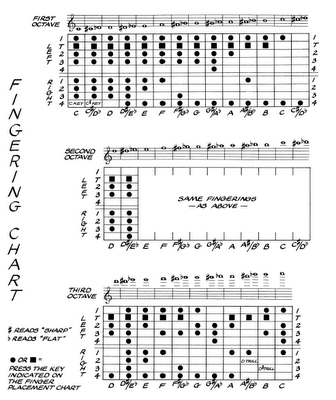 Note 1: The bell must be stopped to play this note.
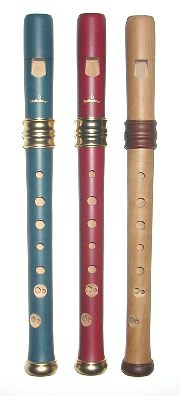
 7:07 PM 26/03/2019Recorders (from top to bottom):