History
The teaching of 'western' music tends to concentrate on a minute fraction of the world's compositions. We must remember that all countries produce music, and usually their musical traditions go back thousands of years. Furthermore, 'western' music has borrowed, even plagiarized, the folk music of many cultures.
Some music is at first alien to 'western' taste, but immersing oneself in another countriy's culture where one hears the music almost daily, can soon bring an unconscious craving for it.
An excellent introduction is Joe Bennett's It's easy to bluff ... Music Theory from Wise Publications at www.musicsales.com
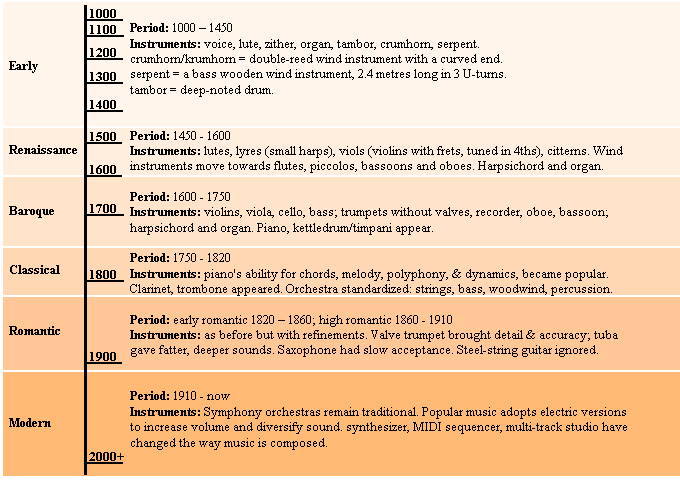
This first chart shows the evolution of instruments and orchestras.
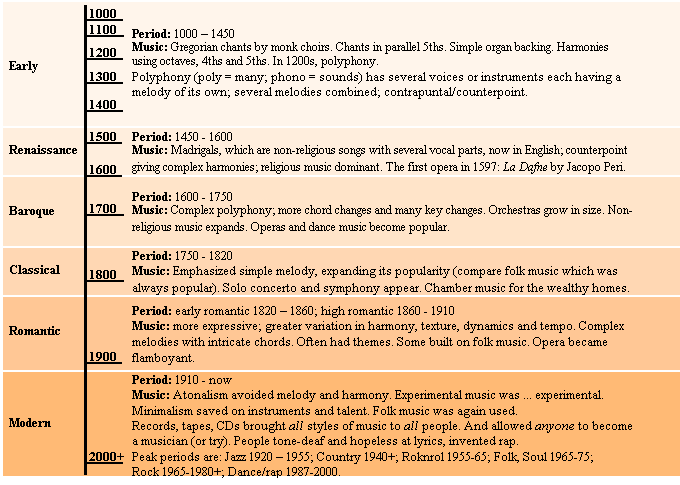
This second chart shows the evolution of the music.
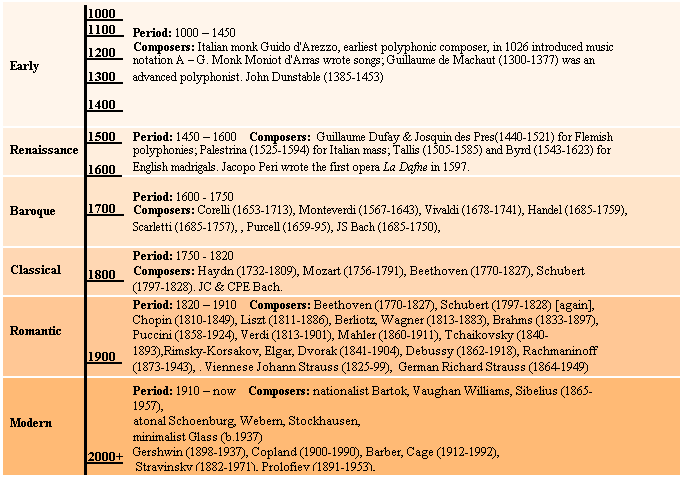
This third chart lists the composers.
Some history can be viewed through the 3 basic elements of music:
This history becomes:
- pre-800: Rhythm and melody are inseparable; melody without rhythm is shapeless and meaningless (although modern meditation music is close).
- 800s: Harmony, although it appeared before the 800 AD, is seen as developing in the 800s with the new use of parallel 4ths and 5ths. While melody is horizontally constructed, harmony is vertically constructed by the use of overtones over the fundamental note. As such it is a much more sophisticated development than melody. Harmonic singing began in the 800s with using the overtones which occurred naturally, doubling a melody at a perfect 4th or 5th.
Next followed singing in 4 parts by doubling both the melody and the parallel voice.
- about 1450s: the 3rd was combined with the 5th, to form a triad (triad = any note + 3rd + 5th above).
- 1400s: The triad is the basic element of 'Western' harmony, and is the main feature up till Schoenburg's atonal music of the 1900s.
- 1500s - 1700: After the introduction of the triad in the 1400s, there was rapid development in technique, and prodigious output peaking in the 1500s. Modality was slowly abandoned as the new major-minor tonal system won ground towards the end of the 1700s.
- 1700 - 1900: This major-minor system along with the triad, ruled supreme in the 'western' world. In spite of developments in the last 100 years, the 'western' audiences generally prefer earlier work.
- 1900 - 2000: