Neurotransmitters
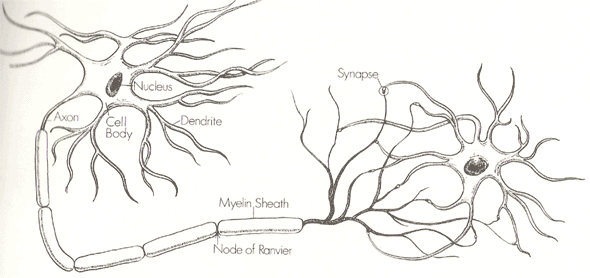
Neurotransmitters: A neuron sends an electrical impulse along it axon which, at its ends, branches several times. Each branch ends at a tiny gap from a receptacle (dendrite) of another neuron. The electrical impulse in the first neuron triggers the release of a chemical, called a neurotransmitter, which passes across the gap to the dendrite. Depending on the type of neurotransmitter, this dendrite might decide to trigger, or decide to not trigger, an electrical impulse along its neuron. And so the message is passed along the line of neurons or blocked.
In this way, neurotransmitters help, excite or inhibit the next neuron (the postsynaptic neuron).
- Acetylcholine (ACh) Released at some neuromuscular and neuroglandular junctions and at synapses between certain brain and spinal cord cells; in most parts of the body, ACh leads to excitation; ACh is inactivated to acetate and choline by acetylcholinesterase (AChE) [the suffix -erase usually means 'breaks down']; blockage of ACh receptors in skeletal muscles leads to myesthenia gravis.
- Serotonin (5-HT) Concentrated in neurons in the raphe nucleus in the brain stem; leads to excitation and may be involved in inducing sleep, sensory perception, temperature regulation, and control of mood.
- Norepinephrine (NE) nor-EPI-nef-rin; released at some neuromuscular and neuroglandular junctions; concentrated in the locus coeruleus (LOH-cus se-ROO-le-us)of the brain stem; NE probably causes excitation in most cases; may be involved in arousal, dreaming and regulation of mood; inactivated by the enzymes catechol-O-methyltransferase (kat-e-kol-O-meth-il_TRANS-fer-as) and monoamine oxidase (mon-o-AM-en OK-si-daz, MAO)
- Glutamic acid & aspartic acid amino acids causing excitation in the brain.
- Gamma aminobutyric acid (GABA) AM-in-o-BU-ti-rik; concentrated in superior and inferior colluculi, thalamus, hypothalamus occipital lobes of the cerebrum; inhibits the brain; probably a target for anti-anxiety drugs such as diazepam (Vallium) which enhance the action of GABA.
- Glycine leads to inhibition in the spinal cord.
- Dopamine (DA) Do-pa-men; concentrated in the midbrain in the substantia nigra; leads to inhibition; involved in emotional responses and subconscious movements of skeletal muscles; decreased levels associated with Parkison's disease; an excess of DA may be involved with schizophrenia.
Back to Contents
Neuropeptides
Neuropeptides are chains of 2 to 40 amino acids occurring naturally in the brain, which act as chemical messengers across neuron synapses (gaps). They can act as neurotransmitters but usually act to modulate the response of or to neurotransmitters.- Enkephalins: (en = without; keph = head); inhibit pain impulses by suppressing substance P and by binding to the same receptors in the brain as morphine does; several times more potent than morphine from the opium poppy; concentrated in the thalamus, hypothalamus, parts of the limbic system, and spinal cord pathways that relay pain impulses.
- Endorphins: inhibit pain by inhibiting substance P; may have a role in memory, learning, sexual activity, control of body temperature; linked to depression and schizophrenia; concentrated in the pituitary gland.
- Substance P: stimulates perception of pain; found in sensory nerves, spinal cord pathways, and parts of the brain associated with pain; endorphins might inhibit pain by suppressing the release of substance P.
- Dynorphin: (dynamis = power); 50 times more powerful than beta-endorphin and 200 times more powerful than morphine; may be related to controlling pain and registering emotions; found in posterior pituitary gland, hypothalamus and small intestine.
- Angiotensin II: may regulate blood pressure within the brain; produced from renin released by the kidneys.
- Cholecystokinin (CCK): may be involved in regulating feeding; produced by the small intestine.
- Regulating hormones: chemicals produced by the hypothalamus that regulate the release of hormones by the pituitary gland.
Back to Contents
Following signal imputs from sensory organs, the brain orgainizes itself, selecting which brain areas to use to process those signals and to offer a response by stimulating the motor areas of the body. What we call our mind, which is merely our conscious mind, has no control over this functioning of the brain.
If enough of these parallel activites are coupled together, remarkable generalizations become possible; new original thoughts can be born.
Each brain cell (neuron) is alive and altered by its experiences and its environment. In their interactions with one another, neurons form and dissolve and reform chemical and electrical patterns that correspond to changes in the internal and external environment. With time these patterns may disappear because of disuse (therefore revison of memorizing is important). [The Mind p257]
Decentralized
Within the brain, vast numbers of nerve cells interact by means of neuronal networks that form and dissolve throughout our lifetime. Every experience is embedded somewhere within these networkds, but each cell retains its individuality. There is no master cell to oversee, integrate or interpret experience. These processes emerge from the action of many independent parallel activities. The human mind is decentralized. [The Mind p250]Following signal imputs from sensory organs, the brain orgainizes itself, selecting which brain areas to use to process those signals and to offer a response by stimulating the motor areas of the body. What we call our mind, which is merely our conscious mind, has no control over this functioning of the brain.
If enough of these parallel activites are coupled together, remarkable generalizations become possible; new original thoughts can be born.
Each brain cell (neuron) is alive and altered by its experiences and its environment. In their interactions with one another, neurons form and dissolve and reform chemical and electrical patterns that correspond to changes in the internal and external environment. With time these patterns may disappear because of disuse (therefore revison of memorizing is important). [The Mind p257]
Back to Contents
Frontal lobe damage interferes with reasoning, abstract thinking, organization of behaviour over time and space, attainment of future goals, initiative, creativity, feelings of personal autronomy and identitiy, and the ethical and moral components of behaviour.[The Mind p268]
Since this prefrontal area is almost an evolutionary addition to the chimpanzee's brain, these facilities are not strong in chimps (we think).
Frontal lobe damage frees the parietal lobe activity, causing the patient to respond to all external stimuli, thus showing that the parietal lobe is normally inhibited by the frontal lobe. The parietal lobe directs us outward towards the external world, while the frontal lobe turns us inward towards abstraction, insight, planning, a sense of personal autonomy, and the ability to see the consequences and appropriateness of our actions.[The Mind p270-1]
Frontal lobe
Even when resting, doing nothing in particular, the anterior prefrontal area displays higher metabolism and regional blood flow than the rest of the brain. [The Mind p266]Frontal lobe damage interferes with reasoning, abstract thinking, organization of behaviour over time and space, attainment of future goals, initiative, creativity, feelings of personal autronomy and identitiy, and the ethical and moral components of behaviour.[The Mind p268]
Since this prefrontal area is almost an evolutionary addition to the chimpanzee's brain, these facilities are not strong in chimps (we think).
Frontal lobe damage frees the parietal lobe activity, causing the patient to respond to all external stimuli, thus showing that the parietal lobe is normally inhibited by the frontal lobe. The parietal lobe directs us outward towards the external world, while the frontal lobe turns us inward towards abstraction, insight, planning, a sense of personal autonomy, and the ability to see the consequences and appropriateness of our actions.[The Mind p270-1]
Back to Contents
But now, functional measures of the resting brain suggest that in smart people, distant areas of the brain communicate with each other more robustly than in less smart people.
In a recent paper, researchers at the Chinese Academy of Sciences, led by Ming Song, examined how resting brain networks differ between people who have superior versus average IQ scores. They found that the posterior cingulate cortex is the hub of the human brain – it is the most widely and intensively connected region of the human brain at rest. Moreover, the strength of connectivity among distant brain regions was greater in people with superior than average IQ scores. Another 2009 study came to a similar conclusion, and noted that the strongest relations between resting connectivity and IQ were observed in the frontal and parietal brain regions, which have been most associated with performance on IQ tests.
Thus, remarkably, the strength of long-distance connections in the resting brain can be related to performance on IQ tests. We are often impressed when people make creative connections between ideas – perhaps long-range connectivity in the brain empowers such mental range.
These “at rest” findings fit well into what we know of how intelligence develops in children. In typical brain development there is a progression from local to distributed network connectivity. In children, there is strong local connection and weak distant connection. That changes with age: local connectivity decreases and long-distance connectivity increases. Intelligence by almost any measure increases with age until young adulthood.
Earlier research also found that slower thinning of the neocortex (often interpreted as pruning of synapses) was associated with higher IQs in children; perhaps the slower pruning allowed for the establishment of long-lasting long-distance connections. Thus, the strength of long-distance connections in the brain may support the growth of intelligence and influence variation in adult intelligence.
Connectivity
[© 2012 Scientific American, a Division of Nature America, Inc. via Internet, April 16, 2012] Neuroscientists have used modern imaging methods to discover the neural correlates of intelligence as measured by widely used tests. Generally, greater grey matter volume or thickness across many brain regions correlates with higher IQ scores. Bilateral frontal and parietal regions are most often associated with performance on intelligence tests.But now, functional measures of the resting brain suggest that in smart people, distant areas of the brain communicate with each other more robustly than in less smart people.
In a recent paper, researchers at the Chinese Academy of Sciences, led by Ming Song, examined how resting brain networks differ between people who have superior versus average IQ scores. They found that the posterior cingulate cortex is the hub of the human brain – it is the most widely and intensively connected region of the human brain at rest. Moreover, the strength of connectivity among distant brain regions was greater in people with superior than average IQ scores. Another 2009 study came to a similar conclusion, and noted that the strongest relations between resting connectivity and IQ were observed in the frontal and parietal brain regions, which have been most associated with performance on IQ tests.
Thus, remarkably, the strength of long-distance connections in the resting brain can be related to performance on IQ tests. We are often impressed when people make creative connections between ideas – perhaps long-range connectivity in the brain empowers such mental range.
These “at rest” findings fit well into what we know of how intelligence develops in children. In typical brain development there is a progression from local to distributed network connectivity. In children, there is strong local connection and weak distant connection. That changes with age: local connectivity decreases and long-distance connectivity increases. Intelligence by almost any measure increases with age until young adulthood.
Earlier research also found that slower thinning of the neocortex (often interpreted as pruning of synapses) was associated with higher IQs in children; perhaps the slower pruning allowed for the establishment of long-lasting long-distance connections. Thus, the strength of long-distance connections in the brain may support the growth of intelligence and influence variation in adult intelligence.
Back to Contents
Each brain cell (neuron) receives signals from more than one neuron and transmits to more than one neuron. Chemicals passing across synapses vary in type and intensity, thus changing and modifying signals. Transmitters can be excitatory or inhibitory. Even the same chemical can sometimes by excitatory and at other times inhibitory.
In their interactions neurons form and dissolve and reform electrical and chemical patterns, and are structurally altered permanently by incoming signals along networks which may later dissolve, leaving those altered neurons intact. Networks connect to other networks but this interconnectedness alters and shifts with time and use or lack of use.
Brains operate several (or many) of their subsystems simultaneously, in parallel processing, enabling us to do several tasks together or to combine several processes into the one task. Any 2 cells or more cell subsystems which are repeatedly active simultaneously become connected by networks which enable them to help each other.
These subsystems can be far apart, suggesting a distributed structure for the brain. It has been suggested that:
Summary
The brain has two independent hemispheres linked to opposite sides of the body, thus development of intelligence requires that both sides of the body must be developed equally, including left and right handedness.Each brain cell (neuron) receives signals from more than one neuron and transmits to more than one neuron. Chemicals passing across synapses vary in type and intensity, thus changing and modifying signals. Transmitters can be excitatory or inhibitory. Even the same chemical can sometimes by excitatory and at other times inhibitory.
In their interactions neurons form and dissolve and reform electrical and chemical patterns, and are structurally altered permanently by incoming signals along networks which may later dissolve, leaving those altered neurons intact. Networks connect to other networks but this interconnectedness alters and shifts with time and use or lack of use.
Brains operate several (or many) of their subsystems simultaneously, in parallel processing, enabling us to do several tasks together or to combine several processes into the one task. Any 2 cells or more cell subsystems which are repeatedly active simultaneously become connected by networks which enable them to help each other.
These subsystems can be far apart, suggesting a distributed structure for the brain. It has been suggested that:
the greater the ability of a brain to connect distant subsystems, and the more subsystems it can connect simultaneously, the more intelligent it is, giving a more informed and more complex response. In this way startlingly new ideas can be generated.
(Obviously we cannot use this as a definiton of intelligence, since we cannot meazure it.)
The brain thus self-assembles and dis-assembles, independently of our conscious endeavours, adding another factor to the genetic and environmental components of intelligence. Is intelligence self-generating, that is, given the same environmental factors, does an intelligent brain automatically increase its intelligence at a faster rate than a less intelligent brain ?
It follows that we need to concentrate on:
In this way we can build on the genetic component. If the genetic component is small, the improvement in absolute terms might seem small, being in proportion to the genetic component, but in relative terms might be substantial. I have witnessed major improvements in even a short time, when care is taken. (The students were first required to accept unanimously the incorporation of the program into their curriculum.)
Education departments underestimate the intelligence and potential of pupils and students. Thus the curriculum is limited and the standards low. The result is very sad - bored, troublesome misfits going nowhere. I think schools are the main cause of delinqency. Occasionally we see 'delinquent' schools turned into progressive schools by appropriate programs, and wonder why these programs or similar ones are not available to all schools. If most schools are left to rot that is the fault of the education departments in charge. There is no acceptable excuse.
Brains can absorb information and process it without conscious awareness. Some of the brain's processing is automatic and cannot be altered consciously, even when we are aware of it. At all times, the brain organizes its own activities, selecting which and how many areas will be involved, and which networks of neurons it will use.
Do we have any say in these decisions of the brain ? Perhaps by learning concepts for thinking, followed by practice, we can condition the brain to choose more efficient networks over the less efficient. I find that, when faced by a new problem, my brain automatically swings into inefficient thinking. My conscious mind then outlines a more efficent way, and tries to keep the brain working along this better track. My brain will often tend to veer away from this unless I am very interested in the topic. My conscious mind, in this case the prefrontal fibers (of the frontal lobe), has to remain focussed throughout, to prevent the brain digressing. Therefore by simply remaining focussed I can considerably increase my intelligence. It is that easy. There is nothing daunting about increasing one's intelligence.
The prefrontal fibers (of the frontal lobe) organize reasoning, abstract thinking, organization of behaviour over time and space, attainment of future goals, initiative, creativity, feelings of personal autonomy and identity, and ethical and moral components of behaviour. [The Mind p268]
Thought and behaviour are influenced by the balance of the frontal and parietal lobes. The parietal lobe directs us outward to our environment, while the frontal lobe directs us inward, to insight, abstraction, planning and personal autonomy. If one lobe is injured, such as by stroke or impact, the other lobe dominates. [The Mind p270-1] Explain orally what would happen in each case.
The brain thus self-assembles and dis-assembles, independently of our conscious endeavours, adding another factor to the genetic and environmental components of intelligence. Is intelligence self-generating, that is, given the same environmental factors, does an intelligent brain automatically increase its intelligence at a faster rate than a less intelligent brain ?
It follows that we need to concentrate on:
- increasing the number of cell assemblies
- broadening the scope or type of cell assemblies
- teaching or training the brain to connect these cell assemblies, across boundaries
- teaching the brain concepts in thinking, and training it to use them
- providing the practice whereby the brain strengthens its networks, and increases its connectivity by speed, distance and complexity
- test the effectiveness of the training
In this way we can build on the genetic component. If the genetic component is small, the improvement in absolute terms might seem small, being in proportion to the genetic component, but in relative terms might be substantial. I have witnessed major improvements in even a short time, when care is taken. (The students were first required to accept unanimously the incorporation of the program into their curriculum.)
Education departments underestimate the intelligence and potential of pupils and students. Thus the curriculum is limited and the standards low. The result is very sad - bored, troublesome misfits going nowhere. I think schools are the main cause of delinqency. Occasionally we see 'delinquent' schools turned into progressive schools by appropriate programs, and wonder why these programs or similar ones are not available to all schools. If most schools are left to rot that is the fault of the education departments in charge. There is no acceptable excuse.
Brains can absorb information and process it without conscious awareness. Some of the brain's processing is automatic and cannot be altered consciously, even when we are aware of it. At all times, the brain organizes its own activities, selecting which and how many areas will be involved, and which networks of neurons it will use.
Do we have any say in these decisions of the brain ? Perhaps by learning concepts for thinking, followed by practice, we can condition the brain to choose more efficient networks over the less efficient. I find that, when faced by a new problem, my brain automatically swings into inefficient thinking. My conscious mind then outlines a more efficent way, and tries to keep the brain working along this better track. My brain will often tend to veer away from this unless I am very interested in the topic. My conscious mind, in this case the prefrontal fibers (of the frontal lobe), has to remain focussed throughout, to prevent the brain digressing. Therefore by simply remaining focussed I can considerably increase my intelligence. It is that easy. There is nothing daunting about increasing one's intelligence.
The prefrontal fibers (of the frontal lobe) organize reasoning, abstract thinking, organization of behaviour over time and space, attainment of future goals, initiative, creativity, feelings of personal autonomy and identity, and ethical and moral components of behaviour. [The Mind p268]
Thought and behaviour are influenced by the balance of the frontal and parietal lobes. The parietal lobe directs us outward to our environment, while the frontal lobe directs us inward, to insight, abstraction, planning and personal autonomy. If one lobe is injured, such as by stroke or impact, the other lobe dominates. [The Mind p270-1] Explain orally what would happen in each case.
Back to Contents
This introduction to the brain explains most terms needed for understanding intelligence. It does not try to provide the detail and scope required for the subjects biology and physiology.
With our understanding of the brain, we can now turn to the mind, in our next chapter.
Conclusion
There are three components to the quality of the brain:- genetic component (what we are born with)
- learned component (from learning and experience)
- brain component (the reforming and restructuring done by and within the brain).
This introduction to the brain explains most terms needed for understanding intelligence. It does not try to provide the detail and scope required for the subjects biology and physiology.
With our understanding of the brain, we can now turn to the mind, in our next chapter.