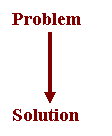
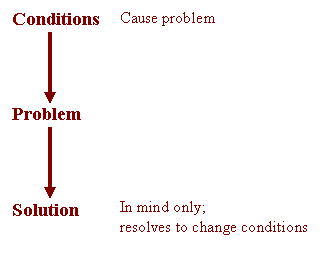
 Can we break down these conditions further ?
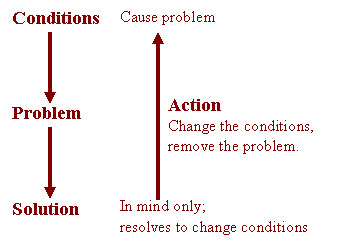
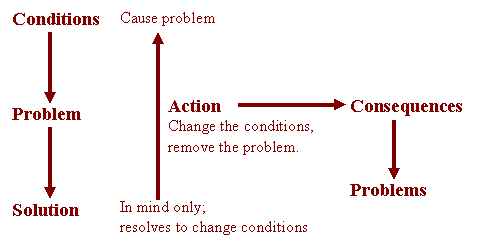
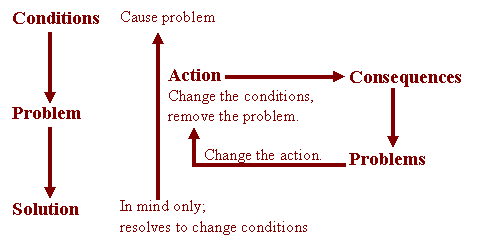
This constant thinking, without rest, exhausts our brain, leads to stress and eventually to failure. The brain during focussed thinking uses more energy, more sugar, than the muscles. Although representing only ~2% of our body weight, the brain consumes ~20% of the energy produced when we are at rest. The brain, like the muscles, is good in short 3-minute bursts, but must then be rested. (Prove me wrong: try focussing on a flame for more than 3 minutes, without having any other thoughts. Better still, focus on a flame without having any thoughts.)
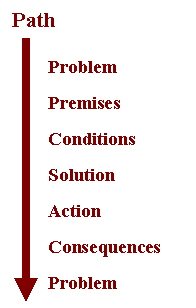 We have now looked at the problem, conditions causing the problem, the solution, the action, the consequences of the action, and the problems caused by the action.
There is one more characteristic of a problem, one which people rarely consider: the premises.
What are the premises ?
The premises are the preconceptions, the philosophy, the hidden assumptions, under which we do our thinking.
To illustrate, I must first re-state the problem.
Obesity is lowering my performance.
My premises are:
If I change one of the premises to:
- My performance is important, therefore obesity is unacceptable.
- My performance is more important than the effort of solving this problem.
- My performance is more important than the effort of the action to be taken to remove the conditions causing the problem.
- My performance is more important than the consequences of the action taken to solve the problem.
- Which performance ?
- Only by ending my obesity can my performance improve.
If I change one of the premises to:
My most important performance is swimming,
suddenly there is no problem. I will accept my obesity as desirable. I may even watch TV longer and eat more. No worries !
If I change the last premise to:
If I change the last premise to:
My performance can be returned without losing weight
then we can search for new ways to improve performance, perhaps ways that no-one has yet discovered. Wow, we could make a lot of money !
As another example, recall an argument for punishing someone, "It's the principal of the thing !" This seems to be an appeal for a high-moral stance, yet is no more than a guise for the premise: "My pride, my ego, is more important than his pain. Grant me the power to make him suffer." Change the premise to: "My pride is less important than his pain."
What then happens to the problem ?
Which brings us back to our intuition. At the beginning I defined intuition as our subconscious ramblings producing radical solutions.
I will extend that to:
Intuition is our subconscious ramblings which,
because they are free of premises,
produce radical solutions.
Instead of being smart, let's be stupid.
Begin with the most ridiculous solutions, and drop them only after proving them impossible.
This is challenging but it can work. The solutions can come swiftly, in number, and be ultra-radical. Next time you have a problem which persists for days, try it.
Another way is to write our premises on paper so we can examine the effect of each one, crossing them out if they do not influence the conditions which cause our problem. The difficulty is that most premises are so subtle a part of our psyche, they remain beyond the conscious. Perhaps friends can see our premises better than we can.
I have not tried it, but probably a notebook in which we write and accumulate our premises for each problem would, over years, provide a very instructive book on our philosophical evolution and help to find pathways to change. I have found that putting myself in unfamiliar situations has wrought fundamental changes to my thinking. Such a book would help decide which situations would be most beneficial. I wish you well in your journey.
Descartes was dealing with philosophy, not expensive projects. In contrast, some project-managers vary with Descartes' 3rd rule, by beginning with the most complex problems, on the principle that if you cannot solve them then dont waste resources solving the simplest.
because they are free of premises,
produce radical solutions.
Remove all premises
One way to remove premises is to start at the extreme.Instead of being smart, let's be stupid.
Begin with the most ridiculous solutions, and drop them only after proving them impossible.
This is challenging but it can work. The solutions can come swiftly, in number, and be ultra-radical. Next time you have a problem which persists for days, try it.
Another way is to write our premises on paper so we can examine the effect of each one, crossing them out if they do not influence the conditions which cause our problem. The difficulty is that most premises are so subtle a part of our psyche, they remain beyond the conscious. Perhaps friends can see our premises better than we can.
I have not tried it, but probably a notebook in which we write and accumulate our premises for each problem would, over years, provide a very instructive book on our philosophical evolution and help to find pathways to change. I have found that putting myself in unfamiliar situations has wrought fundamental changes to my thinking. Such a book would help decide which situations would be most beneficial. I wish you well in your journey.
Complex issues
Here are Descartes' four simple rules:- Accept as true only what is indubitable.
- Divide every question into manageable parts.
- Begin with the simplest issues and ascend to the more complex.
- Review frequently enough to retain the whole argument at once.
Descartes was dealing with philosophy, not expensive projects. In contrast, some project-managers vary with Descartes' 3rd rule, by beginning with the most complex problems, on the principle that if you cannot solve them then dont waste resources solving the simplest.