Premises:
- A gas consists of a vast number of molecules in random motion
- A gas is mostly empty space with a small total volume of molecules
- The molecules exert no forces on each other except when in contact
- No kinetic energy is lost in the perfectly elastic collisions with other molecules and the container. If collisions were not elastic, ke (kinetic energy) would be converted to heat, the temperature would rise, the pressure would fall. Since this does not happen, this premise is acceptable.
- The duration of each collision is very small compared with the time between collisions
- The molecules have a range of speeds.
Laws
- Boyle's Law: pV = a constant for a gas at constant temperature
- Charles' Law: V/T = a constant for a gas at constant pressure
- Avogadro's Law: Equal volumes of different gases, at the same temperature and pressure, have equal numbers of molecules
Argument
Imagine a cube filled with gas. Because the gas is 3 dimensional, we can think of the molecules divided into 3 groups, each group travelling backwards and forwards parallel to one of the 3 axes.
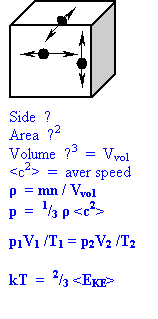
- From (1) & (2), p1V1 /T1 = p2V2 /T2
- From (3) & (4), pV = nkT
- p = pressure (absolute pressure = gauge pressure + 1 atmosphere)
- V = volume
- T = absolute temperature (0K)
- k = 1.38 x 10 - 23 J per molecule per0K (Boltzmann constant)
- n = number of molecules
- n/3 = number of molecules hitting one wall
- m = mass of one molecule
- v = speed of any molecule
- < c2 > = average speed squared of molecules
- l = length of cube
Each molecule travels 2l before hitting same wall twice - From (15), area of wall is l2
- From (13) & (15), time between 2 collisions on same wall
time = 2l / v - From (17), frequency of collisions = v / 2l per second
- From (12) & (13), change of momentum on collision at wall is from + mv to -mv
ΔM = 2mv - From (18) & (19),
rate of change of momentum = 2mv.v/2l = mv2 / l - From (11) & (20), force due to all molecules = n/3 .m <c2> / l
- From (16) & (21),
pressure = Force / area of wall = F/l2 = n.m< c2 > / 3l. l2 = n.m. / 3Vvol - From (10) & (12), density of gas ? = mass / Vvol = m.n / Vvol
- From (22) & (23), pressure p =1/3 ?< c2 >
- From (22),
pVvol = n.m.< c2 > / 3 = 2/3 n.[m< c2 > /2] = 2/3 n.< EKE > where< EKE > = average kinetic energy but from (3), p.Vvol = n.k.T and therefore n.k.T = 2/3 n< EKE > and T = 2/3k< EKE > - Thus temperature is dependent upon the average kinetic energy of the molecules,
and upon nothing else.
This leads to the realization that the temperature of our bodies, upon which our lives depend, is nothing more than the vibration of the molecules. To me, this is a beautiful analytical essay – so simple, clear and concise, with a profound conclusion.