Everything but animal
This chapter includes everything except animals.
Mastering this chapter and the next, is the first step to understanding life itself.
Trace the increasing complexity, always asking:
"What advantage did this change bring ?"
"What disadvantages remain ?"
In the following discussion it will help to remember the sequence of categories:
- Division:
only 3: Archaea, Eubacteria, Eukaryota
- Kingdom:
In Eukarota, now 5 or 6: Protista, (Chromista), Algae ("Green Algae"), Plants, Fungi, Metazoa (Animals)
but this 5 is variable in number, naming and type, according to which article you read. I think of Chromista as a 6th category because, being multicellular, they do not belong to the Protista, and since their photosynthetic pigments are not green chlorophyll they do not belong to the Green Algae.
No system is a Law of Nature. Systems are simply artificial aids to memory. I have chosen this system because many of the leading biologists now use it, and I find it easy to learn and useful.
- Subkingdom:
Sub- = below. For those who like to squeeze an extra category in between Kingdom and Phylum.
- Infrakingdom:
Infra- = below Sub-. For those who need yet another category in between Subkingdom and Phylum.
- Phyla/Phylum:
In plant classifications phyla are usually called divisions.
- Subphylum:
Sub- = below.
- Superclass:
Super = above
- Class:
- Subclass:
- Infraclass:
Infra- = below Sub-.
- Order:
- Superfamily:
Super = above
- Family:
- Genera/Genus:
contains species which can interbreed, but whose hybrid offspring are infertile. Different Genera cannot interbreed.
- Species:
Different species within the one Genus can interbreed but their offspring, called hybrids, are infertile. Examples are a cross between a horse and a donkey (mule, hinny), or between a lion and a tiger (liger, tion).
- Variety:
Within the same specie, varieties can interbreed to produce fertile offspring. However, commercial nurseries cross plant species to give spectacularly-flowering hybrids, resulting in infertile hybrids which produce nectar but no pollen. Thus hybrids fail to provide much-needed protein for our honeyeaters. Please do not buy hybrids.
Most domestic dogs are descended from the wolf, and so are varieties within the species wolf. The wolf is a different species to the African dog, the hyena, the fox, and the many other 'wild' dogs.
As the years go by, biologists find they prefer to have more categories, so categories are added with prefixes Super-, Sub-, Infra-. And as categories are added, old definitions become untidy and inappropriate, so they are dropped. Example: Family is now defined as a taxon between Order and Genus, while Genus is defined as a taxon between Family and Species, and on it goes.
This circularity is unavoidable as categories are often changed.
Perhaps you, as a biologist, will correct this.
Division Archaea
Fossil records suggest that the Archaea (and life in general) appeared on Earth over 3.8 billion years ago, within one billion years of the planet's formation, when the atmosphere of the young Earth was rich in ammonia and methane, and probably very hot.
Such conditions, while toxic to plants and animals, can be quite cozy for archaeans. Rather than being organisms evolved to survive in unusual conditions, the Archaea may represent remnants of once-thriving communities that dominated the world when it was young.
Archaea: Archeal membranes, unlike other organisms, are formed from isoprene chains which are not the same lipids (oily compounds) that other organisms use.:
- Euryarcheota:
include many methanogens (methane producers) and salt-loving archaeans
- Crenarcheota:
include both hi-temp species and moderate temperature species
- Korarcheota:
known only from their DNA sequences (only recently discovered).
Archaeans include inhabitants of some of the most extreme environments on the planet:
- high temperatures: near rift vents in the deep sea at temperatures well over 100 degrees Centigrade;
- in extremely alkaline or acid waters
- inside the digestive tracts of cows, termites, and marine life where they produce methane
- in the anoxic muds of marshes and at the bottom of the ocean
- in petroleum deposits deep underground.
- in the otherwize dessicating extremely saline waters of salt works (eg Halobacterium, a halophilic or "salt-loving" archaean species)
- in the plankton of the open sea.
The Halobacterium uses the light-sensitive pigment bacteriorhodopsin, which gives Halobacterium its color, to provide chemical energy. Bacteriorhodopsin is purple and pumps protons to the outside of the membrane. When these protons flow back, they are used in the synthesis of ATP, which is the energy source of the cell. This protein, bacteriorhodopsin, is chemically very similar to the light-detecting pigment rhodopsin, found in the vertebrate retina.
Division Eubacteria
Eubacteria = true bacteria.
Bacterium
(Click on this image for the large file/chapter: Eubacteria 1)
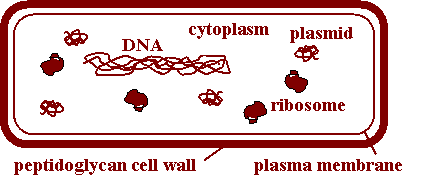
Diagram explained:
- Cytoplasm: the fluid which contains the water, proteins, enzymes, sugars, minerals, etc to maintain the required chemical reactions.
- DNA: forms a tangle known as a nucleoid.
- Plasma membrane: membrane for containing the cytoplasm.
- Plasmid: small loops of DNA.
- Peptidoglycan: carbohydrate polymers cross-linked by proteins.
- Ribosome: granules rich in ribonucleic acid; the sites where proteins are made.
Main features:
- unicellular:
or grouped in clumps or chains
- feeding:
- autotrophic: by chemosynthesis or by photosynthesis
- heterotrophic: by absorption
- reproduction:
- asexual: by binary fission
- sexual: by conjugation
[Coccus: From Gk kokkus = grain, berry, seed]
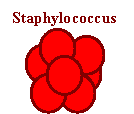
Staphylococcus: spherical cell, may occur as lumps of cells.
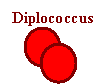
Diplococcus: a pair of cells. [From Gk diploos = double]

Streptococcus: a chain of cells. Pneumonia, meningitis.
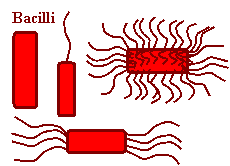
Bacillus: rod-shaped cell, may occur in chains; some have flagella.
Spirillum: spirally-shaped cell with a tuft of flagella.
Vibrio: shaped like a bent rod with a single flagellum.
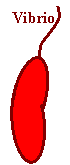
Spirillum
Phylum Cyanobacteria
[cyan = blue]
Cyanobacteria = blue bacteria (as in the misnomer "algal bloom", but it is not algae).
Main features:
- unicellular or filamentous:
with some filamentous forms being branched.
- photosynthesis:
performed on membranes round the periphery of the cells; photosyntheis uses the sun's energy to convert carbon dioxide and water to sugar.
- pigments:
Photosynthetic pigments include chlorophyll, red pigment (phycoerythrin) and blue pigment (phycocyanin).
Chroococcus: single spherical cell which reproduces by binary fission.
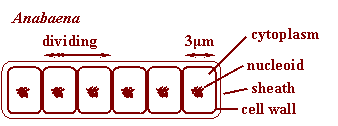
Anabaena: unbranched filament consisting of chain of cells; reproduces by fragmentation; common in freshwater ponds; can fix nitrogen from air.
Division Eukaryota
 Below Chromista, all are unicellular except Rhodophyta ("Red Algae"), altho some form colonies.
Above Chromista, only Choanoflagellata (collar flagellates) and Algae are unicellular.
Metazoa begin with sponges which are like colonies of Choanoflagellata forming a hollow football. This is fixed to substratum at the lower end and open at the other, such that the water (with food) drawn in thru the sides can exit at the mouth at the top.
Kingdom Protista, Phylum Phytoflagellata
Phytoflagellata = plant flagellates
Unicellular Eukaryota with varied types of nutrition including photosynthesis.
both asexual and sexual.
Flagella and cilia, where present, have the 9+2 structure. In some forms the cells are grouped into colonies.
Main features:
- 1 or more flagellates: At some stage in life cycle. Flagella are used for locomotion
- chlorophyll: Usually. For photosynthesising sugars for food.
Phytoflagellata form a major part of phytoplankton, the beginning of the aquatic food cycle; the bottom of the food chain.
Euglena: contains chlorophyll, looks green, occurs in freshwater ponds; photosynthetic and/or heterotrophic-by-absorption.
Peranema: like Euglena but lacks chlorophyll, feeding heterotrophically instead.
Chlamydomonas: pond-dwelling with 2 flagella and cup-shaped chloroplast.
Volvox: spherical colony of up to 20,000 Chlamydomonas-like cells.
Other related phyla include the following photosynthetic but non-flagellated organisms:
Pleurococcus:common non-motile unicell found on damp tree trunks and walls.
Chlorella: non-motile unicell, free-living or symbiotic.
Acetabularia: mushroom-shaped cell.
Diatoms, usually yellow or brown, and green desmids: single cells with hard walls, often containing silica.
Phylum Zooflagellata
Zooflagellata = animal flagellates
Main features:
- 1 or more flagellates: At some stage in life cycle. Flagella are used for locomotion
- no chlorophyll: feed heterotrophically by absorption or phagocytosis.
Trypanosomes: blood parasites carried by tsetse flies on the African savannahs, causing sleeping sickness which kills livestock and people.
Collar flagellates: stalked, sessile; single flagellum creates a water current to draw food into its collar; solitary or colonial. Now categorized as Choanoflagellata.
Phylum Sarcodina
Main features:
- pseudopodia: move by false feet
- heterotrophic: by phagocytosis.
Amoeba: lives in ponds; also marine forms.
Entamoeba: parasitic in mouth cavity and intestine.
Foraminiferans: these shelled amoebas formed calcareous rocks.
Actinospherium: slender pseudopodia, stiffened by microtubules, radiate from central body mass.
Phylum Ciliophora
Main features:
- cilia: at some stage in life cycle;; used for locomotion or creating a feeding current.
- heterotrophic: usually by phagocytosis
- 2 nuclei: mega- & micro-nucleus; micro for sexual conjugation only.
Paramecium: free-swimming, cilia thruout life.
Stylonichia: groups of cilia fused to form leg-like cirri for locomotion.
Vorticella: stalked, sessile; cilia for feeding only.
Suctorians: have cilia during development only; adult has one or more suctorial tentacles for feeding.
Phylum Sporozoa
Main features:
- wriggle: move by wriggling; no external locomotory devices.
- spores: reproduce by spores.
- parasitic: all are parasitic, feeding heterotrophically.
Plasmodium: blood arasite, causing malaria.
Monocystis: parasite in seminal vesicles of earthworm.
Kingdom of "In-betweens"
Phylum Rhodophyta, Phylum Phaeophyta, Phylum Chlorophyta
I learn these 3 phyla as a group because they have:
- a close connection with Kingdom Protista
- one characteristic separating them from Kingdom Plantae
- 4 characteristics separating them from Kingdom Metazoa
Phyla Rhodophyta, Phaeophyta and Chlorophyta are multi-cellular Eukaryota with photosynthetic nutrition.
Cells typically have
:
- cellulose wall
- sap vacuole
- plastids
- several photosynthetic pigments which always include chlorophyll a
These 4 characteristics separate these 3 phyla and Plantae from Kingdom Metazoa.
These 3 phyla all have a simple body form called a
thallus which is
not differentiated into the roots, stem and leaves with vascular tissues
typical of Plants/Plantae.
Kingdom Plantae slowly adds in this order
:
- stem and leaves (Bryophyta)
- roots and vascular tissues (Tracheophyta)
- seeds (Spermatophyta).
You should write down the advantages of each development.
Phylum Rhodophyta
Main features:
- photosynthetic pigments:
- chlorophyll
- phycoerythrin (red) (dominates)
- phycocyanin (blue)
- many forms: from disks to multi-branched seaweeds.
Rhodomela: forms bushy tufts attached to rocks and stones in rock pools on the shore.
Phylum Phaeophyta
Main features:
- photosynthetic pigments:
- chlorophyll
- fucoxanthin (brown) (dominates)
- complex: the most complex of all the algae with considerable cell differentiation.
Fucus: common seaweed of intertidal zone; thallus differentiated into holdfast for clinging to rocks; tough stipe; flat slippery fronds.
Laminaria: similar to Fucus but with large elongated fronds.
Kingdom Chlorophyta "Green Algae"
Mostly green, aquatic, from unicellular thin green soup to simple multicellular sea lettuce.
From now on, in the increasing complexity of our evolutionary tree, green chlorophyll wins over other photosynthetic pigments. Why ?
What superior advantages does green chlorophyll bring ?
Which of the green chlorophylls win ? Where ? Why ?
Main features:
- photosynthetic pigments: green chlorophyll dominates. (As we go up the evolutionary chain, we see photosynthetic pigments being used, and gradually green chlorophyl dominates. This helps us remember the sequence of phyla. Deciduous trees turning yellow and red in autumn remind us that even trees carry non-green photosynthetic pigments.)
- thallus: usually filamentous or flattened with little or no cell differentiation.
Spirogyra: unbranched filament consisting of a chain of identical walls, each containing one or more spiral chlorplasts; free-floating in freshwater ponds, etc.
Oedogonium: similar to Spirogyra but with special basal cell for attachment to stones, etc.
Kingdom Plantae
Phylum Bryophyta
[-phyta from Gk
phuton = plant]
Main features:
- hapliod-diploid: life cycle alternates betwee the haploid, gamete-producing gametophyte and the diploid spore-producing sporophyte, with the gametophyte being the prominant phase.
- gametophyte: is usually differentiated into simple stem and leaves but without vascular tissue; filamentous rhizoids for anchorage.
- sporophyte: attached to, and derives nourishment from, the gametophyte; its most obvious feature is the spore capsule (sporangium) which is carried at the end of a slender stalk above the gametophyte.
Plants/Animals
Plant cells are eukaryotic and have many of the structures found in animal cells.
Plant cells differ from animal cells:
- in lacking:
- centrioles
- intermediate filaments
- and having:
- plastids
- cell wall
- large vacuoles.
Class Hepaticae (liverworts)
Aquatic or semi-terrestrial gametophyte with thalloid body or simple stem and leaves; rhizoid unicellular.
Pellia: common thallid liverwort growing on banks of streams, etc.
'Leafy' liverworts are differentiated into very simple stem and leaves.
Class Musci (mosses)
Similar to liverworts but gametophytes always differentiated into simple stem and leaves; rhizoids multicellular.
Funaria: common moss growing on rock, wste ground, walls, etc.
Mnium: woodland moss similar to Funaria.
Polytrichum: large moss in moorlands.
Sphagnum: bog moss thriving in wet areas where soil is acidic.
Phylum Tracheophyta
[tracheo- from Gk trakheia = rough (but used as an abbreviation for 'rough artery', as in the windpipe 'trachea'); -phyta from Gk phuton = plant]
What a giant leap forward.
'Veins' to transport water up and sugars down.
This enables organisms to grow tall. The main restriction now is the lack of structure which adds strength; for this they will need lignin in the cell walls.
Main features:
- haplid-diploid: life cycle alternates betwee the haploid, gamete-producing gametophyte and the diploid spore-producing sporophyte, with the sporophyte being the prominant phase.
- sprophyte differentiated: into roots, stems, and leaves with vascular tissues
- lignified tissues
Subphylum Pteridophyta
[Pterido- from Gk pteris, pterid- = fern; phyto = plant.]
Gametophyte reduced to small simple pro-thallus.
Class Filicales (ferns)
Large prominent leaves (fronds) bearing spore-capsules (sporangia) on undersides.
Dryopteris: common fern of woods and hillsides with large divided fronds and underground rhizome (stem).
Hart's tongue: similar to Dryopteris but fronds undivided.
Class Equisetales (horsetails)
Upright stem bears whorls of small leaves at nodes and spore-prodcuning 'cone' at apex.
Equisetum: the only living genus; often found in wet places.
Class Lycopodiales (clubmosses)
Not mosses but small-leaved pteridytes. Leaves generally densely arrranged on branching stem, with sporangia in between.
Lycopodium: common on moorland and hills; sporangia in terminal cones at the end of branches.
Selaginella: sporophyte produces 2 types f spore: microspore and megaspore which develop into male and female prothalli respectively. Prothalli, particularly male, much reduced.
Subphylum Spermatophyta
Spermato-phyta = seed-plants.
From now on, all plants will propagate by seeds because this gives them a great advantage over the non-seed plants.
Gametophyte reduced to small simple pro-thallus.
Class Gymnospermae
[Gk gymnos = naked; Gk speirein = to sow >> L sperm = sperm or seed;
gymnosperm = 'naked seed' = conifers, gingko, cycads]
Reproductive structures carried on spore-bearing leaves massed together into cones. Ovules unprotected. No vessels in xylem, only tracheids.
Pinus: the pine tree with needle-like leaves and prominent cones.
Also fir, larch, cypress, cedar, redwood, yew.
Class Angiospermae
[Gk aggeion = vessel; angiosperm = seed-in-vessel = flowering plants in which pollen (sperm) enters an ovum]
Reproductive structures in flowers. Ovules protected within ovary. After fertilization ovary develops into fruit. Xylum contains vessels.
Subclass Monocotyledons
Embryo has one seed-leaf (cotyledon); leaves generally have parallel veins, as in grasses, flax, rushes, Palmacae (eg coconut palm).
Stem contains scattered vascular bundles; cambium tissue absent so secondary growth does not occur so, with the exception of palms, monocots do not achieve great size.
Liliaceae (eg bluebell),; Juncaceae (eg rush); Iridaceae (eg iris); Orchidaceae (eg bird's nest orchid); Graminae (eg wheat, rice, other grasses); Palmaceae (eg coconut palm).
Subclass Dicotyledons
Embryo has 2 seed-leaves (cotyledons); leaves generally have a network of veins (exceptions: acacia); stem contains rings of vascular bundles; cambium tissue present so secondary growth occurs.
Ranunculaceae (eg buttercup); Rosaceae (eg rose); Cruciferae (eg wall flower); Leguminosae (eg pea); Labiatae (eg deadnettle); Compositae (eg daisy); Hyperacaceae (eg St John's wort); Euphorbiaceae (eg spurge); Cactaceae (eg prickly pear).
Dicots include many trees: eucalupt, acacia, oak, beech, birch, lime, elm, horse chestnut.
Kingdom Fungi
Main features:
- multicellular Eukaryota
- absorptive heterotrophic nutrition
- Body usually consists of a mycelium (network) of thread-like hyphae with cellulose or chitinous walls (there are exceptions).
- In some forms the hyphae are divided into multi-nucleate compartments by cross-walls (septa); in other forms the hyphae are undivided.
- no plastids
- Reproduction by spores produced asexually, or by simple conjugation.
Phylum Zygomycetes
Main features:
- asexual: by non-motile spores produced from a stalked spore case (sporangium)
- sexual: by conjugation between neighbouring hyphae.
Mucor: 'pin mold', lives saprotrophically on jam, bread, etc.
Phylum Oomycetes
Main features:
- asexual: by non-motile conidia and/or motile, flagellated zoospores
- sexual: by fusion of a male gamete with an egg contained inside an oogonium.
Peronospora: parasite of flowering plants.
Phytophthora: potato blight fungus.
Pythium: causes 'damping off' of seedlings.
Phylum Ascomycetes
Main features:
- sexual: by conjugation, followed by the formation of ascospores inside a sac-like ascus.
- asci: may be grouped in a cup-shaped perithecium.
Sordaria: grows naturally on dung of herbivorous mammals; easily cultured on agar.
Neurospora: bread mould, used to establish the one-gene enzyme hypothesis.
Pencillium: grows on a wide range of foods; the antibiotic penicillin is obtained from it.
Yeast: unicellular fungus which feeds saprotrophically on sugars; can respire anaerobically and reproduces by budding or fission. Ascospores, formed after sexual reproduction, indicates its ascomycetes category.
Phylum Basidiomycetes
Main features:
- asexual: by means of basidiospores which are produced on a microscopic, club-shaped basidium.
- basidia: located in a fruiting body made of densely packed hyphae.
Mushroom: mycelium saprotrophic in soil; familiar 'mushroom' is the spore-producing fruiting body.
Puccinia: causes black rust, a serious disease of wheat and other cereals.
Phylum Myxomycetes
Main features:
- cellular slime molds: growing in damp places eg soil, rotting tree trunks.
- Life cycle: free-living 'amoebas' aggregate into a slimy multinucleate 'slug' which forms a spore-producing sporangium; thespores develop into a new generation of 'amoebas'.
Dictyostelium: a slime mold.
Other Phyla
plasmodial slime molds: similar to the cellular slime molds but more complicated;
lichens: dual organisms consisting of a fungus combined mutualistically with green protists or blue-green bacteria.