Alveolates
Alveolates are a very recently recognized group, which indicates the state of flux in which biology moves.
Detailed studies of the internal structure of these protists demonstrates that they all share a system of sacs underneath their cell membranes. These closely packed sacs are called alveoli. (The tiny air-sacs in our lungs are also called alveoli.)
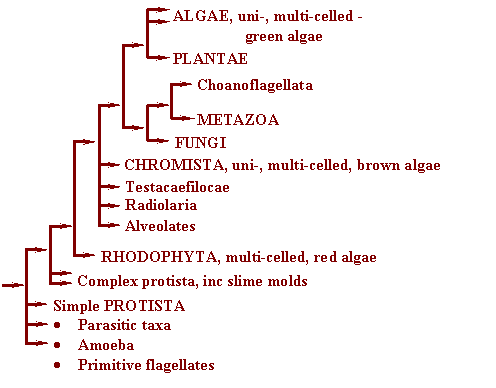
Alveolates include: [Click blue words for links.]
- Ciliata:
[Then click back-arrow to return.]
[L. cilia = eyelash]
Ciliata, or Ciliophora or ciliates, some or all of the surface of a ciliate is covered with cilia, relatively short, dense hairlike structures which beat to propel the ciliate through the water and/or to draw in food particles.
Ciliates include some of the most complex and largest free-living single-celled protists; a few genera may reach two millimeters in length. They are abundant in almost every environment with liquid water: ocean waters, marine sediments, lakes, ponds, and rivers, and even soils.
- Foraminifera:
Also very diverse, Foraminifera are used as fossils by paleontologists to date rocks, determine paleoclimate, and search for oil deposits.
- Dinoflagellates:
Dinoflagellates are photosynthetic, able to manufacture their own food from sunlight, carbon dioxide, and sufficient dissolved nutrients. The dinoflagellates are best known for their periodic population booms that result in "red tides" that may kill fish and shellfish.
- Apicomplexa:
Apicomplexa are a group of parasitic and disease-causing protists, known for complex life cycles.