Fungi macro

** Click images to enlarge. **
Button-mushrooms
button mushrooms not found


The cultivated mushroom as well as the common field mushroom initially form a minute fruiting body, referred to as the pin stage because of their small size.
Slightly expanded they are called buttons, once again because of the relative size and shape. Once such stages are formed, the mushroom can rapidly pull in water from its mycelium and expand, mainly by inflating preformed cells that took several days to form in the primordia.

Fungi categories:
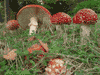
Amanita muscaria
<i>Amanita muscaria</i> or 'fly agaric'

Definition

The Kingdom Mycophyta/Fungi (Myceteae): multicelular eukaryota with absorptive heterotrophic (osmophilic) nutrition.
However, there is no undisputed definition of fungi, so here are are the sum of properties:
The fungi are clearly delineated from the plants and other autotrophs because the vegetative body or thallus of the fungus, even when it forms tissues, is never differentiated into root and shoot and, most important of all, has no specialised vessels for internal transport of nutrients.

While closer to animals than plants, fungi are different from the metazoa in many ways. They are eukaryotic organisms and, in contrast to monerans (prokaryotes: archaebacteria and eubacteria), they have true nuclei surrounded by nuclear membrane and containing chromosomes.

The fungi are chemo-organo-trophic organisms, having no chlorophylls and performing no function like photosynthesis. They cannot use carbon dioxide as their carbon source and are dependent on external sources for organic carbon.

Whether the fungi represent a single phylum of organisms with a common ancestors is matter of debate among students for their phylogeny and classification. They range from very simple, short-lived, unicellular structures. whose single cell becomes the organ of reproduction to massive perennial mycelia giving rise to great frutification as in some of the puffballs, pore fungi etc. Except for the lack of chlorophyll and the saprophytic or parasitic mode of life, these two extremes have no single character in common: manner of reproduction, structure of vegetative body, chemical composition of cell wall etc.

The simplicity of one type of fungus might indicate either a lower position in evolutionary hierarchy, or simplification from a complex organization. The lack of fossils prevents direct evidence on this.

Mushrooms & toadstools

The mushroom is a fruit.
Spores
Spores not found
A mushroom is the fleshy, spore-bearing fruit of a fungus, typically produced above ground on soil or on its food source.
The word mushroom is most often applied to those fungi (Basidiomycota, Agaricomycetes) that have:
In general, fungi with fruit bodies that have a cap more or less centrally placed on top of a stem are referred to as ‘mushrooms’, or as ‘mushrooms and toadstools’. Some people broadly consider that all fungi with a cap and stem are ‘mushrooms’, while others consider only edible fungi as ‘mushrooms’. In the strictest sense, the word ‘mushroom’ refers only to members of the genus Agaricus, e.g. the cultivated white button mushroom.
 
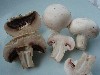
Agaricus bisporus
Button mushrooms

<i>Agaricus bisporus</i> or button mushrooms  not found
‘Toadstool’ is typically applied to any fungus with a cap and stem that appears different from Agaricus, regardless of its edibility, or more usually if it is suspected or known to be poisonous. In a broader sense, ‘toadstools’ also includes other non-mushroom forms of fungi such as puffballs, earthstars, and coral fungi.
Amanita_muscaria
'fly agaric'

<i>Amanita muscaria</i> or 'fly agaric'  not found
Forms deviating from the standard morphology usually have more specific names, such as "puffball", "stinkhorn", and "morel", and gilled mushrooms themselves are often called "agarics" in reference to their similarity to Agaricus or their placement in the order Agaricales. By extension, the term "mushroom" can also designate the entire fungus when in culture or the thallus (called a mycelium) of species forming the fruiting bodies called mushrooms, or the species itself.
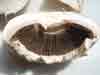
Lamellae
Lamellae of <i>Agaricus bisporus</i> or button mushrooms not found

Identification

Identifying mushrooms requires a basic understanding of their macroscopic structure. Most are Basidiomycetes and gilled. Their spores, called basidiospores, are produced on the gills and fall in a fine rain of powder from under the caps as a result. (Put them on a newspaper to catch the spores, then spread around a moist spot in your garden.)
Stages
lamellae not found
At the microscopic level the basidiospores are shot off of basidia and then fall between the gills in the dead air space. As a result, for most mushrooms, if the cap is cut off and placed gill-side-down overnight, a powdery impression reflecting the shape of the gills (or pores, or spines, etc.) is formed when the fruitbody is sporulating.
The color of the powdery print, called a spore print, is used to help classify mushrooms and can help to identify them. Spore print colors include white (most common), brown, black, purple-brown, pink, yellow, and cream, but almost never blue, green, or red.

While modern identification of mushrooms is quickly becoming molecular, the standard methods for identification are still used by most and have developed into a fine art harking back to medieval times and the Victorian era, combined with microscopic examination. The presence of juices upon breaking, bruising reactions, odors, tastes, shades of color, habitat, habit, and season are all considered by mycologists, amateur and professional alike. Tasting and smelling mushrooms carries its own hazards because of poisons and allergens. Chemical tests are also used for some genera.
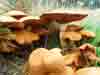
Brown mushroom
<i>Agaricus ????</i> or brown mushroom  not found
In general, identification to genus can often be accomplished in the field using a local mushroom guide. Identification to species, however, requires more effort; one must remember that a mushroom develops from a button stage into a mature structure, and only the latter can provide certain characteristics needed for the identification of the species.
However, over-mature specimens lose features and cease producing spores. Many novices have mistaken humid water marks on paper for white spore prints, or discolored paper from oozing liquids on lamella edges for colored spored prints.

too many people die from eating wild mushrooms. One Englishman, picking wild mushrooms in his beloved countryside, destroyed the organs of his guests in only one meal - it was either transplant or die. Australian mushrooms are unique and so foreign texts do not apply. People from China, with all their experience in mushrooms, have been known to die from eating Australian mushrooms. I now tell mushroom-picking hosts that I am allergic to mushrooms (and eat only shop bought ones).

Classification

Classification is as for this field mushroom:
Kingdom Mycophyta/Fungi (Myceteae)
Phylum Basidiomycetes
Class Agaricomycetes
Order Agaricales
Genus Agaricus
Species Agaricus campestris.

Typical mushrooms are the fruitbodies of members of the order Agaricales, whose type genus is Agaricus and type species is the field mushroom, Agaricus campestris. However, in modern molecularly defined classifications, not all members of the order Agaricales produce mushroom fruitbodies, and many other gilled fungi, collectively called mushrooms, occur in other orders in the class Agaricomycetes.

Within the main body of mushrooms, in the Agaricales, are common fungi like the common fairy-ring mushroom (Marasmius oreades), shiitake, enoki, oyster mushrooms, fly agarics, and other amanitas, magic mushrooms like species of Psilocybe, paddy straw mushrooms, shaggy manes, etc.

An atypical mushroom is the Lobster mushroom, which is a deformed, cooked-lobster-colored parasitized fruitbody of a Russula or Lactarius colored and deformed by the mycoparasitic Ascomycete Hypomyces lactifluorum.

Other mushrooms are non-gilled, and then the term "mushroom" is loosely used, so that it is difficult to give a full account of their classifications. Some have pores underneath (and are usually called boletes), others have spines, such as the hedgehog mushroom and other tooth fungi, and so on. "Mushroom" has been used for polypores, puffballs, jelly fungi, coral fungi, bracket fungi, stinkhorns, and cup fungi. Thus, the term mushroom is more one of common application to macroscopic fungal fruiting bodies than one having precise taxonomic meaning. There are approximately 14,000 described species of mushrooms.

Polypore
polypore not found
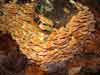
A polypore is a mushroom without a stalk, such as the genus Trichaptum here fruiting on a log.

Growth rates

Many species of mushrooms seemingly appear overnight, growing or expanding rapidly. Actually all species of mushrooms take several days to form primordial mushroom fruit bodies, though they do expand rapidly by the absorption of fluids. The cultivated mushroom as well as the common field mushroom initially form a minute fruiting body, referred to as the pin stage because of their small size. Slightly expanded they are called buttons, once again because of the relative size and shape. Once such stages are formed, the mushroom can rapidly pull in water from its mycelium and expand, mainly by inflating preformed cells that took several days to form in the primordia.

Similarly, there are even more ephemeral mushrooms, like Parasola plicatilis (formerly Coprinus plicatlis), that literally appear overnight and may disappear by late afternoon on a hot day after rainfall. The primordia form at ground level in lawns in humid spaces under the thatch and after heavy rainfall or in dewy conditions balloon to full size in a few hours, release spores, and then collapse. They "mushroom" to full size.

Not all mushrooms expand overnight; some grow very slowly and add tissue to their fruitbodies by growing from the edges of the colony or by inserting hyphae.

Size and age

Though mushroom fruiting bodies are short-lived, the underlying mycelium can itself be long-lived and massive. A colony of Armillaria ostoyae in Malheur National Forest in the United States is estimated to be 2,400 years old, possibly older, and spans an estimated 2,200 acres. Most of the fungus is underground and in decaying wood or dying tree roots in the form of white mycelia combined with black shoelace-like rhizomorphs that bridge colonized separated woody substrates.

Human use

Oyster mushroom (Pleurotus ostreatus) is cultivated using artificial logs made from compacted sawdust in plastic containers, harvested early morning. The button mushroom (Agaricus bisporus) is one of the most widely cultivated mushrooms in the world. The Chinese cultivate many diverse-looking mushrooms.

Edible mushrooms

Edible mushrooms are used extensively in cooking, in many cuisines (notably Chinese, European, and Japanese). Though mushrooms are commonly thought to have little nutritional value, many species are high in fiber and provide vitamins such as:
Though not normally a significant source of vitamin D, some mushrooms can become significant sources after exposure to ultraviolet light, though this also darkens their skin.

Most mushrooms that are sold in super markets have been commercially grown on mushroom farms. The most popular of these, Agaricus bisporus, is generally considered safe for most people to eat because it is grown in controlled, sterilized environments, though some individuals do not tolerate it well. Several varieties of A. bisporus are grown commercially, including whites, crimini, and portobello. Other cultivated species now available at many grocers include shiitake, maitake or hen-of-the-woods, oyster, and enoki.

Toxic mushrooms

There are a number of species of mushroom that are poisonous, and although some resemble certain edible species, eating them could be fatal. Eating mushrooms gathered in the wild is risky and should not be undertaken by individuals not knowledgeable in mushroom identification, unless the individuals limit themselves to a relatively small number of good edible species that are visually distinctive. However even A. bisporus contains 'agaritine' which metabolises when eaten into hydrazine, which is carcinogenic, but this chemical is largely or completely removed by cooking.

More generally, and particularly with gilled mushrooms, separating edible from poisonous species requires meticulous attention to detail; there is no single trait by which all toxic mushrooms can be identified, nor one by which all edible mushrooms can be identified. Additionally, even edible mushrooms may produce an allergic reaction, from a mild asthmatic response to severe anaphylaxis shock.

Of central interest with respect to the chemical properties of mushrooms is the fact that many species produce secondary metabolites that render them toxic, mind-altering, or even bioluminescent.

Although there are only a small number of deadly species, several others can cause particularly severe and unpleasant symptoms.

Toxicity likely plays a role in protecting the function of the basidiocarp: the mycelium has expended considerable energy and protoplasmic material to develop a structure to efficiently distribute its spores. One defense against consumption and premature destruction is the evolution of chemicals that render the mushroom inedible, either causing the consumer to vomit or to avoid future consumption.

Psychoactive mushrooms

Psilocybin mushrooms possess psychedelic properties. They are commonly known as "magic mushrooms" "mushies" or "shrooms" and are available in many parts of the world, though some countries have outlawed their sale. An article in the Journal of Psychopharmacology has made correlations between the induced hallucinations and subjects' experiences up to several months later.

Because of their psychoactive properties, some mushrooms have played a role in native medicine, where they have been used in an attempt to effect mental and physical healing, and to facilitate visionary states.

Psilocybin mushrooms are not the only psychoactive fungi. Amanita muscaria pictured above is also psychoactive. The active constituents are Ibotenic acid and Muscimol. The Muscaria chemotaxonomic group of Amanitas contain no amatoxins or phallotoxins, and are not hepatoxic. Some dry these in the sun to transform the Ibotenic acid into the more psychoactive Muscimol.

Medicinal mushrooms

Maitake, shiitake, Agaricus blazei, chaga, and reishi are prominent among those being researched for their potential anti-cancer, anti-viral, or immunity-enhancing properties.

Psilocybin, originally an extract of certain psychedelic mushrooms, is being studied for its ability to help people suffering from mental disease, such as obsessive-compulsive disorder. Minute amounts have been reported to stop cluster and migraine headaches.

In a recent case-control study of the eating habits of 2,018 woman, consumption of mushrooms was linked with approximately 50% reduction in breast cancer. Woman who consumed mushrooms and green tea had a 90% lower occurrence of breast cancer.

Other uses

Mushrooms can be used for dyeing wool and other natural fibers. The chromophores of mushrooms are organic compounds and produce strong and vivid colors, and all colors of the spectrum can be achieved with mushroom dyes. Before the invention of synthetic dyes mushrooms were the source of many textile dyes.

Some types of polypores have been used as fire starters (known as tinder fungi).

Mushrooms and other fungi play a role in the development of effective biological remediation and filtration technologies.